

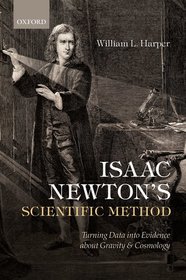
Isaac Newton's Scientific Method
Turning Data into Evidence about Gravity and Cosmology
- Publisher's listprice GBP 40.49
-
18 281 Ft (17 410 Ft + 5% VAT)
The price is estimated because at the time of ordering we do not know what conversion rates will apply to HUF / product currency when the book arrives. In case HUF is weaker, the price increases slightly, in case HUF is stronger, the price goes lower slightly.
- Discount 10% (cc. 1 828 Ft off)
- Discounted price 16 452 Ft (15 669 Ft + 5% VAT)
Subcribe now and take benefit of a favourable price.
Subscribe
18 281 Ft

Availability
printed on demand
Why don't you give exact delivery time?
Delivery time is estimated on our previous experiences. We give estimations only, because we order from outside Hungary, and the delivery time mainly depends on how quickly the publisher supplies the book. Faster or slower deliveries both happen, but we do our best to supply as quickly as possible.
Product details:
- Publisher OUP Oxford
- Date of Publication 16 October 2014
- ISBN 9780198709428
- Binding Paperback
- No. of pages444 pages
- Size 233x162x22 mm
- Weight 758 g
- Language English 0
Categories
Short description:
William L. Harper presents a compelling new account of Isaac Newton's work on gravity and the cosmos. He argues that Newton's inferences from phenomena realize an ideal of empirical success that is richer than prediction, and explores the ways in which Newton's method aims to turn theoretical questions into ones which can be answered empirically.
MoreLong description:
Isaac Newton's Scientific Method examines Newton's argument for universal gravity and his application of it to resolve the problem of deciding between geocentric and heliocentric world systems by measuring masses of the sun and planets. William L. Harper suggests that Newton's inferences from phenomena realize an ideal of empirical success that is richer than prediction. Any theory that can achieve this rich sort of empirical success must not only be able to predict the phenomena it purports to explain, but also have those phenomena accurately measure the parameters which explain them. Harper explores the ways in which Newton's method aims to turn theoretical questions into ones which can be answered empirically by measurement from phenomena, and to establish that propositions inferred from phenomena are provisionally accepted as guides to further research. This methodology, guided by its rich ideal of empirical success, supports a conception of scientific progress that does not require construing it as progress toward Laplace's ideal limit of a final theory of everything, and is not threatened by the classic argument against convergent realism. Newton's method endorses the radical theoretical transformation from his theory to Einstein's. Harper argues that it is strikingly realized in the development and application of testing frameworks for relativistic theories of gravity, and very much at work in cosmology today.
In virtue of the significance of Newton's result for the history of science, Harper's book is an important contribution.
Table of Contents:
Preface
Acknowledgements
An Introduction to Newton's Scientific Method
Newton's Phenomena
Inferences from Phenomena (Propositions 1 and 2 Book 3)
Unification and the Moon-Test (Propositions 3 and 4 Book 3)
Christiaan Huygens: A great Natural Philosopher who measured gravity and an illuminating foil for Newton on method
Unification and the Moon-test: Critical Assessment
Generalization by Induction (Propositions 5 and 6 Book 3)
Gravity as a Universal Force of Interaction (Propositions 7- 13 Book 3)
Beyond Hypotheses: Newton's Methodology vs. Hypothetico-Deductive Methodology
Newton's Methodology and the Practice of Science
Bibliography
Index

