

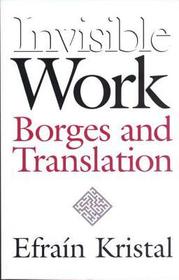
Invisible Work – Borges and Translation
Borges and Translation
- Publisher's listprice GBP 32.00
-
14 448 Ft (13 760 Ft + 5% VAT)
The price is estimated because at the time of ordering we do not know what conversion rates will apply to HUF / product currency when the book arrives. In case HUF is weaker, the price increases slightly, in case HUF is stronger, the price goes lower slightly.
- Discount 10% (cc. 1 445 Ft off)
- Discounted price 13 003 Ft (12 384 Ft + 5% VAT)
Subcribe now and take benefit of a favourable price.
Subscribe
14 448 Ft

Availability
Estimated delivery time: In stock at the publisher, but not at Prospero's office. Delivery time approx. 3-5 weeks.
Not in stock at Prospero.
Why don't you give exact delivery time?
Delivery time is estimated on our previous experiences. We give estimations only, because we order from outside Hungary, and the delivery time mainly depends on how quickly the publisher supplies the book. Faster or slower deliveries both happen, but we do our best to supply as quickly as possible.
Product details:
- Edition number 1
- Publisher University of Chicago Press
- Date of Publication 1 May 2002
- Number of Volumes Paperback
- ISBN 9780826514080
- Binding Paperback
- See also 9780826514073
- No. of pages280 pages
- Size 215x139x14 mm
- Weight 320 g
- Language English
- Illustrations bibliography, index 0
Categories
Short description:
This work reveals that behind every tale by Borges there pulses a generative translation. Efrain Kristal brings to light the extent to which Borges' methods as translator intervene in the conception and execution of his fictions.
MoreLong description:
It is well known that Jorge Luis Borges was a translator, but this has been considered a curious minor aspect of his literary achievement. Few have been aware of the number of texts he translated, the importance he attached to this activity, or the extent to which the translated works inform his own stories and poems. Between the age of ten, when he translated Oscar Wilde, and the end of his life, when he prepared a Spanish version of the Prose Edda, Borges transformed the work of Poe, Kafka, Hesse, Kipling, Melville, Gide, Faulkner, Whitman, Woolf, Chesterton, and many others. In a multitude of essays, lectures, and interviews Borges analyzed the versions of others and developed an engaging view about translation. He held that a translation can improve an original, that contradictory renderings of the same work can be equally valid, and that an original can be unfaithful to translation. Borges's bold habits as translator and his views on translation had a decisive impact on his creative process. Translation is also a recurrent motif in Borges's stories. In ""The Immortal,"" for example, a character who has lived for many centuries regains knowledge of poems he had authored, and almost forgotten, by way of modern translations. Many of Borges's fictions include actual or imagined translations, and some of his most important characters are translators. In ""Pierre Menard, author of the Quixote,"" Borges's character is a respected Symbolist poet, but also a translator, and the narrator insists that Menard's masterpiece - his ""invisible work"" - adds unsuspected layers of meaning to Cervantes's Don Quixote. George Steiner cites this short story as ""the most acute, most concentrated commentary anyone has offered on the business of translation."" In an age where many discussions of translation revolve around the dichotomy faithful/unfaithful, this book will surprise and delight even Borges's closest readers and critics.
More
