

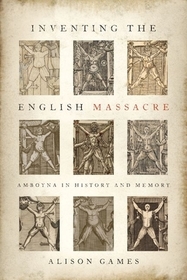
Inventing the English Massacre
Amboyna in History and Memory
- Publisher's listprice GBP 37.99
-
17 152 Ft (16 335 Ft + 5% VAT)
The price is estimated because at the time of ordering we do not know what conversion rates will apply to HUF / product currency when the book arrives. In case HUF is weaker, the price increases slightly, in case HUF is stronger, the price goes lower slightly.
- Discount 10% (cc. 1 715 Ft off)
- Discounted price 15 437 Ft (14 702 Ft + 5% VAT)
Subcribe now and take benefit of a favourable price.
Subscribe
17 152 Ft

Availability
Estimated delivery time: In stock at the publisher, but not at Prospero's office. Delivery time approx. 3-5 weeks.
Not in stock at Prospero.
Why don't you give exact delivery time?
Delivery time is estimated on our previous experiences. We give estimations only, because we order from outside Hungary, and the delivery time mainly depends on how quickly the publisher supplies the book. Faster or slower deliveries both happen, but we do our best to supply as quickly as possible.
Product details:
- Publisher OUP USA
- Date of Publication 22 June 2020
- ISBN 9780197507735
- Binding Hardback
- No. of pages324 pages
- Size 239x163x27 mm
- Weight 612 g
- Language English
- Illustrations 34 halftones 0
Categories
Short description:
This book tells the story of the causes and legacies of a conspiracy trial featuring English, Japanese, and Indo-Portuguese plotters against Dutch spice traders in the Indian Ocean in 1623. In the wake of the torture and execution of the accused men, the incident became known in Europe as the Amboyna Massacre. I trace the creation and memory of the Amboyna Massacre over four hundred years, providing a new interpretation of a poorly understood episode once believed by historians to have changed the course of British history. It did, but not as people once thought: instead, it became the first English massacre and this new history of the Amboyna Massacre explains why we associate massacres with intimacy, treachery, and cruelty.
MoreLong description:
My Lai, Wounded Knee, Sandy Hook: the place names evoke grief and horror, each the site of a massacre. Massacres-the mass slaughter of people-might seem as old as time, but the word itself is not. It worked its way into the English language in the late sixteenth century, and ultimately came to signify a specific type of death, one characterized by cruelty, intimacy, and treachery. How that happened is the story of yet another place, Amboyna, an island in the Indonesian archipelago where English and Dutch merchants fought over the spice trade. There a conspiracy trial featuring English, Japanese, and Indo-Portuguese plotters took place in 1623 and led to the beheading of more than a dozen men in a public execution.
Inventing the English Massacre shows how the English East India Company transformed that conspiracy into a massacre through printed works, both books and images, which ensured the story's tenacity over four centuries. By the eighteenth century, the story emerged as a familiar and shared cultural touchstone and a term that needed no further explanation. By the nineteenth century, the Amboyna Massacre became the linchpin of the British empire, an event that historians argued well into the twentieth century had changed the course of history and explained why the British had a stronghold in India. The broad familiarity with the incident and the Amboyna Massacre's position as an early and formative violent event turned the episode into the first English massacre.
Drawing on archival documents in Dutch, French, and English, Alison Games masterfully recovers the history, ramifications, and afterlives of this event, which shaped the meaning of subsequent acts of violence and made intimacy, treachery, and cruelty indelibly connected with massacres.
Games's work has made a significant contribution to British colonial history by investigating the genealogy of a central, yet often-overlooked theme: massacre. Instead of treating the term as a static concept, Games skillfully investigated how the term's changing meanings reflect and distort people's memories of a particular historical event.
Table of Contents:
Acknowledgments
A Note on Dates and Spelling
Cast of Characters
Introduction
Chapter 1 From Competition to Conspiracy
Chapter 2 The Amboyna Business
Chapter 3 Inventing the Amboyna Massacre
Chapter 4 The Reckoning
Chapter 5 Domesticating Amboyna
Chapter 6 Legacies: Reinvention and the Linchpin of Empire
Epilogue The First English Massacre
Appendix 1 Deposition Abbreviations
Appendix 2 True Relations
Appendix 3 A Note on Sources and Methodology
Notes
Index

