

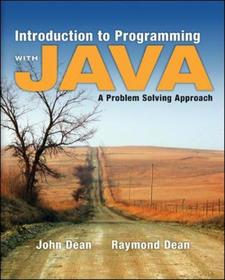
Introduction to Programming with Java: A Problem Solving Approach
- Publisher's listprice GBP 112.99
-
53 980 Ft (51 410 Ft + 5% VAT)
The price is estimated because at the time of ordering we do not know what conversion rates will apply to HUF / product currency when the book arrives. In case HUF is weaker, the price increases slightly, in case HUF is stronger, the price goes lower slightly.
- Discount 10% (cc. 5 398 Ft off)
- Discounted price 48 582 Ft (46 269 Ft + 5% VAT)
Subcribe now and take benefit of a favourable price.
Subscribe
53 980 Ft

Availability
Out of print
Why don't you give exact delivery time?
Delivery time is estimated on our previous experiences. We give estimations only, because we order from outside Hungary, and the delivery time mainly depends on how quickly the publisher supplies the book. Faster or slower deliveries both happen, but we do our best to supply as quickly as possible.
Product details:
- Publisher McGraw-Hill
- Date of Publication 1 January 2008
- ISBN 9780073047027
- Binding Hardback
- No. of pages848 pages
- Size 233x188x30 mm
- Weight 1173 g
- Language English 0
Categories
Long description:
This book teaches the reader how to write programs using Java. It does so with a unique approach that combines fundamentals first with objects early. The book transitions smoothly through a carefully selected set of procedural programming fundamentals to object-oriented fundamentals. During this early transition and beyond, the book emphasizes problem solving. For example, Chapter 2 is devoted to algorithm development, Chapter 8 is devoted to program design, and problem-solving sections appear throughout the book. Problem-solving skills are fostered with the help of an interactive, iterative presentation style: Here's the problem. How can we solve it? How can we improve the solution?
Some key features include:
?A conversational, easy-to-follow writing style.
?Many executable code examples that clearly and efficiently illustrate key concepts.
?Extensive use of UML class diagrams to specify problem organization.
?Simple GUI programming early, in an optional standalone graphics track.
?Well-identified alternatives for altering the book's sequence to fit individual needs.
?Well-developed projects in six different academic disciplines, with a handy summary.
?Detailed customizable PowerPointTM lecture slides, with icon-keyed hidden notes.
Student Resources:
Instructor Resources:
Supplemental Chapters to Accommodate an Objects-Late Approach are available.
"The authors have done a superb job of organizing the various chapters to allow the students to enjoy programming in Java from day one. I am deeply impressed with the entire textbook. I would have my students keep this text and use it throughout their academic career as an excellent Java programming source book". - Benjamin B. Nystuen, University of Colorado at Colorado Springs
"The authors have done a great job in describing the technical aspects of programming. The authors have an immensely readable writing style. I have an extremely favorable impression of Dean and Dean's proposed text". - Shyamal Mitra, University of Texas at Austin
"The overall impression of the book was that it was ?friendly? to read. I think this is a great strength, simply because students reading it, and especially students who are prone to reading to understand, will appreciate this approach rather than the regular hardcore programming mentality". - Andree Jacobson, University of New Mexico
This book teaches the reader how to write programs using Java. It does so with a unique approach that combines fundamentals first with objects early. The book transitions smoothly through a carefully selected set of procedural programming fundamentals to object-oriented fundamentals. During this early transition and beyond, the book emphasizes problem solving. For example, Chapter 2 is devoted to algorithm development, Chapter 8 is devoted to program design, and problem-solving sections appear throughout the book. Problem-solving skills are fostered with the help of an interactive, iterative presentation style: Here's the problem. How can we solve it? How can we improve the solution?
Some key features include:
?A conversational, easy-to-follow writing style.
?Many executable code examples that clearly and efficiently illustrate key concepts.
?Extensive use of UML class diagrams to specify problem organization.
?Simple GUI programming early, in an optional standalone graphics track.
?Well-identified alternatives for altering the book's sequence to fit individual needs.
?Well-developed projects in six different academic disciplines, with a handy summary.
?Detailed customizable PowerPointTM lecture slides, with icon-keyed hidden notes.
Student Resources:
Instructor Resources:
Supplemental Chapters to Accommodate an Objects-Late Approach are available.
"The authors have done a superb job of organizing the various chapters to allow the students to enjoy programming in Java from day one. I am deeply impressed with the entire textbook. I would have my students keep this text and use it throughout their academic career as an excellent Java programming source book". - Benjamin B. Nystuen, University of Colorado at Colorado Springs
"The authors have done a great job in describing the technical aspects of programming. The authors have an immensely readable writing style. I have an extremely favorable impression of Dean and Dean's proposed text". - Shyamal Mitra, University of Texas at Austin
"The overall impression of the book was that it was ?friendly? to read. I think this is a great strength, simply because students reading it, and especially students who are prone to reading to understand, will appreciate this approach rather than the regular hardcore programming mentality". - Andree Jacobson, University of New Mexico
More
