

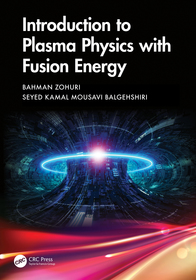
Introduction to Plasma Physics with Fusion Energy
-
GET 10% OFF
- Publisher's listprice GBP 235.00
-
106 102 Ft (101 050 Ft + 5% VAT)
The price is estimated because at the time of ordering we do not know what conversion rates will apply to HUF / product currency when the book arrives. In case HUF is weaker, the price increases slightly, in case HUF is stronger, the price goes lower slightly.
- Discount 10% (cc. 10 610 Ft off)
- Discounted price 95 492 Ft (90 945 Ft + 5% VAT)
95 492 Ft

Availability
printed on demand
Why don't you give exact delivery time?
Delivery time is estimated on our previous experiences. We give estimations only, because we order from outside Hungary, and the delivery time mainly depends on how quickly the publisher supplies the book. Faster or slower deliveries both happen, but we do our best to supply as quickly as possible.
Product details:
- Edition number 1
- Publisher CRC Press
- Date of Publication 30 March 2026
- ISBN 9781041131267
- Binding Hardback
- No. of pages406 pages
- Size 254x178 mm
- Weight 940 g
- Language English
- Illustrations 520 Illustrations, black & white 675
Categories
Short description:
Written as an introduction to both Plasma Physics and plasma driven fusion technology, both from the Inertial Confinement Fusion (ICF) and Magnetic Confinement Fusion (MCF) point of view, to introduce these technologies using a fast-paced yet simple approach.
MoreLong description:
Scientists have been trying to replicate the same fusion reactions that drive stars on Earth since the beginning of the nuclear era. To create plasmas where light nuclei may overcome electrostatic repulsion and unleash enormous amounts of energy, hydrogen isotopes must be heated to hundreds of millions of degrees to achieve controlled nuclear fusion. There are now two primary approaches — inerrtial Confinement Fusion (ICF), which uses intense lasers or particle beams to compress tiny fuel pellets to extremely high densities, and Magnetic Confinement Fusion (MCF), which was pioneered by devices like tokamaks and stellarators, which use strong magnetic fields to confine plasma. When combined, these strategies reflect humanity's most audacious quest for clean, practically endless energy.
This book provides a thorough analysis of both ICF and MCF systems, combining their experimental successes, theoretical underpinnings, and technology difficulties into one volume. It gives readers an unbiased, multidisciplinary perspective on the fusion industry by relating lab research to astrophysical processes and future power generation. This study emphasizes the complementarities, common challenges, and larger scientific and socioeconomic context that propels fusion research ahead, in contrast to previous texts that treat each approach independently.
Key features of this book include:
- Clear explanations of the physics of plasma confinement, heating, and ignition in both MCF and ICF.
- Coverage of landmark facilities worldwide, from ITER and stellarators to the National Ignition Facility (NIF).
- Comparative analysis of confinement strategies, ignition schemes, and prospects for commercial viability.
- Connections between fusion experiments, astrophysical phenomena, and national security applications.
- A forward-looking assessment of research frontiers, emerging hybrid concepts, and pathways toward fusion power plants.
This book is a complete introduction and reference on controlled fusion, written for physics, engineering, and energy science professionals, researchers, and graduate students. In addition to offering readers both technical depth and useful insight into the endeavour to harness the power of the stars, it distinguishes itself by linking the two main fusion perspectives.
More
Table of Contents:
1. Foundation of Vector Analysis 2. Foundation of Electrostatics and Electromagnetic Theory 3. Principal of Plasm Physics 4. Controlled Thermonuclear Fusion Driving Confinement Systems 5. The Problem and Challenges of Controlled Fusion 6. Toroidal Magnetic Confinement 7. The Tokamak System 8. Magnetic Mirror System 9. Stellarator Magnetic Confinement Systems 10. Inertial confinement 11. Alternate Confinement Concepts 12. Nuclear Fusion Reactors Fuel Cycles 13. Fusion Confinement Related Safeties – Burning Plasma 14. Nuclear Fusion Energy Economics
More
