

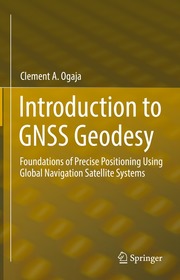
Introduction to GNSS Geodesy
Foundations of Precise Positioning Using Global Navigation Satellite Systems
-
GET 12% OFF
- Publisher's listprice EUR 171.19
-
66 866 Ft (63 682 Ft + 5% VAT)
The price is estimated because at the time of ordering we do not know what conversion rates will apply to HUF / product currency when the book arrives. In case HUF is weaker, the price increases slightly, in case HUF is stronger, the price goes lower slightly.
- Discount 12% (cc. 8 024 Ft off)
- Discounted price 58 842 Ft (56 040 Ft + 5% VAT)
58 842 Ft

Availability
Out of print
Why don't you give exact delivery time?
Delivery time is estimated on our previous experiences. We give estimations only, because we order from outside Hungary, and the delivery time mainly depends on how quickly the publisher supplies the book. Faster or slower deliveries both happen, but we do our best to supply as quickly as possible.
Product details:
- Edition number 1st ed. 2022
- Publisher Springer
- Date of Publication 26 May 2022
- Number of Volumes 1 pieces, Book
- ISBN 9783030918200
- Binding Hardback
- No. of pages166 pages
- Size 235x155 mm
- Weight 481 g
- Language English
- Illustrations 5 Illustrations, black & white; 38 Illustrations, color 0
Categories
Short description:
Introduction to GNSS Geodesy is a concise reference for beginners and experts in GNSS-based satellite geodesy. It covers all of the important concepts in almost a third of the space of the other GNSS books. Th e book begins with a case study in Augmented Reality to set the stage for what is to come and then moves on to the key elements of GNSS geodesy that make accurate and precise geopositioning possible. For example, it is important to understand the geodetic reference systems and the associated GNSS data processing strategies that enable both accurate and high-precision geopositioning. Chapter 2 gives an overview of GNSS constellations and signals, highlighting important characteristics. Chapter 3 then introduces reference systems in geodesy, covering such topics as time systems, geodetic datums, coordinate systems, coordinate conversions and transformations, and International Terrestrial Reference Frame. Th is lays the framework for the rest of the book.
Chapters 4 and 5 dig deep into mathematical formulation of GNSS parameter estimation and observation models. All the concepts are presented clearly and concisely, with diagrams to assist reader comprehension. Chapter 6 describes Continuously Operating Reference Station (CORS) networks and their role in geodesy and definition of reference frames. Various global and regional CORS networks are presented in this section. Th e chapter also covers GNSS data and common formats such as RINEX and RTCM. Chapter 7 introduces the whole cycle of GNSS data processing, including preprocessing, ambiguity fixing, and solution reprocessing methods as commonly used in both epoch solutions and time series data. Th e book concludes with appendices on orbit modelling, GNSS linear combinations, application examples, and an example linear model.
Long description:
Introduction to GNSS Geodesy is a concise reference for beginners and experts in GNSS-based satellite geodesy. It covers all of the important concepts in almost a third of the space of the other GNSS books. Th e book begins with a case study in Augmented Reality to set the stage for what is to come and then moves on to the key elements of GNSS geodesy that make accurate and precise geopositioning possible. For example, it is important to understand the geodetic reference systems and the associated GNSS data processing strategies that enable both accurate and high-precision geopositioning. Chapter 2 gives an overview of GNSS constellations and signals, highlighting important characteristics. Chapter 3 then introduces reference systems in geodesy, covering such topics as time systems, geodetic datums, coordinate systems, coordinate conversions and transformations, and International Terrestrial Reference Frame. Th is lays the framework for the rest of the book.
Chapters 4 and 5 dig deep into mathematical formulation of GNSS parameter estimation and observation models. All the concepts are presented clearly and concisely, with diagrams to assist reader comprehension. Chapter 6 describes Continuously Operating Reference Station (CORS) networks and their role in geodesy and definition of reference frames. Various global and regional CORS networks are presented in this section. Th e chapter also covers GNSS data and common formats such as RINEX and RTCM. Chapter 7 introduces the whole cycle of GNSS data processing, including preprocessing, ambiguity fixing, and solution reprocessing methods as commonly used in both epoch solutions and time series data. Th e book concludes with appendices on orbit modelling, GNSS linear combinations, application examples, and an example linear model.
Table of Contents:
Chapter 1-Introduction.- Chapter 2-Reference systems in GNSS geodesy.- Chapter 3-Estimating geodetic parameters from GNSS.- Chapter 4-GNSS satellite tracking and observation models.- Chapter 5-Geodetic CORS and tracking networks.- Chapter 6-Satellite orbit determination.- Chapter 7-GNSS data processing and biases.- Chapter 8-GNSS software and online tools.- Chapter 9-GNSS geodetic solution exchange formats.- Chapter 10-GNSS time series combinations and data products.- Chapter 11-Geospatial applications of GNSS geodesy.- Chapter 12-Scientific applications of GNSS geodesy.
More
