

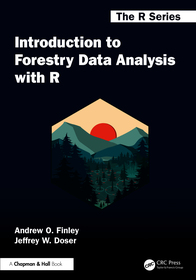
Introduction to Forestry Data Analysis with R
Series: Chapman & Hall/CRC The R Series;
-
GET 10% OFF
- Publisher's listprice GBP 171.99
-
77 653 Ft (73 955 Ft + 5% VAT)
The price is estimated because at the time of ordering we do not know what conversion rates will apply to HUF / product currency when the book arrives. In case HUF is weaker, the price increases slightly, in case HUF is stronger, the price goes lower slightly.
- Discount 10% (cc. 7 766 Ft off)
- Discounted price 69 887 Ft (66 560 Ft + 5% VAT)
69 887 Ft

Availability
Not yet published.
Why don't you give exact delivery time?
Delivery time is estimated on our previous experiences. We give estimations only, because we order from outside Hungary, and the delivery time mainly depends on how quickly the publisher supplies the book. Faster or slower deliveries both happen, but we do our best to supply as quickly as possible.
Product details:
- Edition number 1
- Publisher Chapman and Hall
- Date of Publication 25 September 2026
- ISBN 9781032120287
- Binding Hardback
- No. of pages624 pages
- Size 254x178 mm
- Weight 453 g
- Language English
- Illustrations 93 Illustrations, color; 93 Line drawings, color; 20 Tables, black & white; 20 Tables, color 700
Categories
Short description:
As forestry, ecology, and natural resource management become increasingly data-driven, professionals are expected not only to collect information but also to organize, analyze, visualize, and defend quantitative results.
MoreLong description:
Introduction to Forestry Data Analysis with R equips students and practitioners with the skills needed to move confidently between field measurements and modern analytical workflows. As forestry, ecology, and natural resource management become increasingly data-driven, professionals are expected not only to collect information but also to organize, analyze, visualize, and defend quantitative results. This book responds to that shift by integrating foundational forest inventory concepts with practical computing in R.
Distinct from both generic programming texts and traditional mensuration references, this volume teaches R through real forestry datasets and operational examples. The first half develops core programming skills—data wrangling, visualization, and reproducible workflows—while the second half applies these tools to forest inventory, monitoring, and estimation. Classical methods developed by forest biometricians are presented alongside transparent, step-by-step computational implementations, enabling readers to connect statistical theory with modern, repeatable analysis.
Key Features:
- Introduces R and the tidyverse using forestry-specific datasets and management questions
- Develops reproducible workflows for data import, cleaning, transformation, visualization, and reporting
- Presents forest inventory concepts including simple random, systematic, stratified, cluster, and multistage sampling
- Implements classical estimators using script-based computing
- Integrates spatial data handling and mapping for areal sampling frames and field-based applications
- Emphasizes practical problem-solving, code organization, and analytical habits that scale from single stands to large inventories
Introduction to Forestry Data Analysis with R is intended for undergraduate and graduate students in forestry, natural resources, and environmental science, as well as practitioners seeking to modernize and streamline their analytical workflows. Whether readers are learning R for the first time or adapting established inventory methods to contemporary datasets, it provides a clear, practical, and reproducible foundation for data-driven forest analysis.
MoreTable of Contents:
1 Overviewandmotivating data. 2 Introduction to R and RStudio. 3 Scripts and reproducibleworkflows. 4 Data structures. 5 Functions and functional programming. 6 Data summary and analysiswith tidyverse. 7 Manipulating and summarizing datawith dplyr. 8 Tidying datawith tidyr. 9 Creating graphicswith ggplot2. 10 Preliminary definitions and concepts. 11 Basic statistical concepts. 12 Estimating forest parameters. 13 Sampling designs and estimation in forest inventory. 15 Stratified sampling. 16 Estimation using covariates. 17 Cluster sampling. 18 Multistage sampling.
More
