

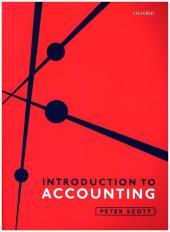
Introduction to Accounting
- Publisher's listprice GBP 48.99
-
22 118 Ft (21 065 Ft + 5% VAT)
The price is estimated because at the time of ordering we do not know what conversion rates will apply to HUF / product currency when the book arrives. In case HUF is weaker, the price increases slightly, in case HUF is stronger, the price goes lower slightly.
- Discount 10% (cc. 2 212 Ft off)
- Discounted price 19 906 Ft (18 959 Ft + 5% VAT)
Subcribe now and take benefit of a favourable price.
Subscribe
22 118 Ft

Availability
Uncertain availability. Please turn to our customer service.
Why don't you give exact delivery time?
Delivery time is estimated on our previous experiences. We give estimations only, because we order from outside Hungary, and the delivery time mainly depends on how quickly the publisher supplies the book. Faster or slower deliveries both happen, but we do our best to supply as quickly as possible.
Product details:
- Edition number 1
- Publisher Oxford University Press
- Date of Publication 27 February 2018
- ISBN 9780198783282
- Binding Paperback
- No. of pages664 pages
- Size 266x174x27 mm
- Weight 1395 g
- Language English 0
Categories
Short description:
'Introduction to Accounting' is the most practical introductory book for accounting and finance students, packed with supportive learning features and both worked and real life examples, and accompanied by a wealth of online resources.
MoreLong description:
Peter Scott's 'Introduction to Accounting' provides a thorough but accessible and engaging introduction to the subject for first year accounting and finance students.
This highly practical textbook uses a multitude of worked and real life examples, supportive learning features, crystal clear explanations, and extensive online resources (fully integrated with the book) to guide students towards a confident understanding of the fundamentals of accounting. Scott's distinctively lively writing style sets the numerical content within an easy-to-follow narrative, and the real life relevance of each tool or technique is explained at every turn. All key areas of
first year courses are covered to provide a solid foundation for more advanced modules, with two chapters and an extensive online case study dedicated to the important topic of double-entry bookkeeping.
The book's online resources include a wealth of free-to-access materials, which are complemented by Dashboard, our online assessment and homework platform. The online resources are fully downloadable into a university's local VLE.
The online student resources include:
- Interactive Multiple Choice Questions for revising key topics;
- Numerical exercises for practising the calculation of accounting information from given sets of data;
- 'Go back over this again' features containing a mix of further examples, written exercises, true or false questions, and annotated accounting information to help consolidate learning and revise or revisit concepts;
- 'Show me how to do it' videos that provide practical demonstrations of dealing with more complex accounting tasks;
- Web links for primary source material and articles through which readers can learn more about the companies and organizations discussed in the book.
Dashboard, our online learning and assessment tool, features:
- Quizzes. A test bank of over 500 ready-to-use questions, tailored specifically to the book's content, giving lecturers the flexibility they need to manage, set and develop quizzes tailored to their course;
- Gradebook. Automatically grades student responses to quizzes, while its visual heat maps provide at-a-glance information about student achievement and engagement;
- Course content. Additional material to support teaching, including a large double-entry case study, PowerPoint slides, and more examples and solutions;
- Communication. Lecturers can share course news, spark a class discussion, or email students with course information, all through the communication tab.
With its clear, logical structure, stimulating exercises, and user-friendly feel, this is an excellent text that will really make a difference to students' learning. Dr Androniki Triantafylli, Queen Mary University of London

