

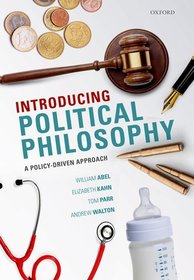
Introducing Political Philosophy
A Policy-Driven Approach
- Publisher's listprice GBP 34.99
-
16 716 Ft (15 920 Ft + 5% VAT)
The price is estimated because at the time of ordering we do not know what conversion rates will apply to HUF / product currency when the book arrives. In case HUF is weaker, the price increases slightly, in case HUF is stronger, the price goes lower slightly.
- Discount 10% (cc. 1 672 Ft off)
- Discounted price 15 044 Ft (14 328 Ft + 5% VAT)
Subcribe now and take benefit of a favourable price.
Subscribe
16 716 Ft

Availability
Estimated delivery time: In stock at the publisher, but not at Prospero's office. Delivery time approx. 3-5 weeks.
Not in stock at Prospero.
Why don't you give exact delivery time?
Delivery time is estimated on our previous experiences. We give estimations only, because we order from outside Hungary, and the delivery time mainly depends on how quickly the publisher supplies the book. Faster or slower deliveries both happen, but we do our best to supply as quickly as possible.
Product details:
- Edition number 1
- Publisher OUP Oxford
- Date of Publication 18 February 2021
- ISBN 9780198783275
- Binding Paperback
- No. of pages296 pages
- Size 250x175x15 mm
- Weight 456 g
- Language English 88
Categories
Short description:
Offering a uniquely policy-driven approach, Introducing Political Philosophy is the only text to showcase contemporary policy problems through the lens of key debates in political philosophy.
MoreLong description:
Introducing Political Philosophy is a thought-provoking introduction that invites readers to consider and analyse the philosophical controversies that underpin several prominent areas of political debate.
The opening chapter familiarises students with the aims and methods of political philosophy. It explains the tools required to practice the discipline, and discusses how to apply these to political arguments. Each of the fifteen subsequent chapters focuses on a distinct area of public policy, such as affirmative action, humanitarian intervention, immigration, and parental leave. The authors introduce students to the moral questions that lie at the heart of these political disputes, as well as to some of the relevant academic literature.
The authors believe that the best way to learn about political philosophy is to see it in action. By arguing for a position in each chapter and defending it against criticisms, they demonstrate to students how political philosophy can inform our analysis of public policy.
Introducing Political Philosophy is available for students and institutions to purchase in a variety of formats, and is supported by online resources.
The e-book offers a mobile experience and convenient access along with hyperlinks a list of web-links, and self-test questions, helping to test your knowledge and understanding of policy areas, and the philosophical arguments that influence them: www.oxfordtextbooks.co.uk/ebooks.
· Student resources: a curated list of websites help you to deepen your knowledge of policy areas, and self-test questions help you to critically evaluate key points from each chapter.
· Lecturer resources include: seminar activities to encourage student engagement, discussion and debate; guidance on using the teaching activities; a teaching guide explaining how to get the most out of the book's inside-out approach; and customisable PowerPoint slides on key topics, thinkers, and concepts to aid effective teaching preparation.
Table of Contents:
Doing Political Philosophy
Euthanasia and Freedom
Hate Speech and Freedom of Expression
Recreational Drugs and Paternalism
Affirmative Action and Discrimination
Schools and Equality of Opportunity
Basic Income and Distributive Justice
Parental Leave and Gender Equality
Minority Exemptions and Multiculturalism
Judicial Review and Democracy
Prison Sentences and Punishment
Intensive Animal Farming and Moral Status
Environmental Taxes and Intergenerational Justice
Immigration and the Political Community
Development Aid and Global Justice
Humanitarian Intervention and Political Self-Determination

