

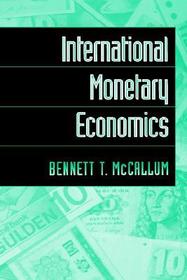
International Monetary Economics
- Publisher's listprice GBP 74.99
-
35 826 Ft (34 120 Ft + 5% VAT)
The price is estimated because at the time of ordering we do not know what conversion rates will apply to HUF / product currency when the book arrives. In case HUF is weaker, the price increases slightly, in case HUF is stronger, the price goes lower slightly.
- Discount 10% (cc. 3 583 Ft off)
- Discounted price 32 243 Ft (30 708 Ft + 5% VAT)
Subcribe now and take benefit of a favourable price.
Subscribe
35 826 Ft

Availability
Uncertain availability. Please turn to our customer service.
Why don't you give exact delivery time?
Delivery time is estimated on our previous experiences. We give estimations only, because we order from outside Hungary, and the delivery time mainly depends on how quickly the publisher supplies the book. Faster or slower deliveries both happen, but we do our best to supply as quickly as possible.
Product details:
- Publisher OUP USA
- Date of Publication 30 May 1996
- ISBN 9780195094947
- Binding Hardback
- No. of pages280 pages
- Size 240x160x23 mm
- Weight 535 g
- Language English
- Illustrations line figures, tables 0
Categories
Short description:
This is an introduction to the major topics in international monetary economics. The subject has become of increasing importance as world trade has grown and regional economic blocs, like the European Monetary System, have emerged. The book will concentrate on the concepts and relationships involving exchange rates and balance of payment magnitudes, the construction and manipulation of exchange rates, and a description of multi-country co-operation
arrangements.
Long description:
It focuses clearly and simply on the underlying economics of exchange rate dtermination and balance of payments. In Part I the author presents basic concepts within historical perspectives of the US and Global Economy. Part II intriduces a basic analytical model - usable with fixed and floating exchange rates, in which capital mobility is complete, real exchange rates are variable, and investment spending is endogenous. Variants of the model are used for short and
long-run comparative static analysis. In addition, there is a relatively long chapter devoted to dynamic analysis with rational expectations. Part III contains three chapters on policy, including a full chapter on the European Moneatry System.
Table of Contents:
Introduction
Exchange Rate Concepts
Balance of Payments Accounts
Historical Perspective
A Basic Model: Building Blocks
Long Run and Short Run Analysis
Analysis With Fixed Exchange Rates
Expectations and Dynamic Analysis
Empirical Evidence
Fixed vs. Floating Exchange Rates
The European Monetary System
International Policy Co-operation

