

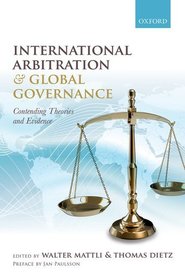
International Arbitration and Global Governance
Contending Theories and Evidence
- Publisher's listprice GBP 61.00
-
27 541 Ft (26 230 Ft + 5% VAT)
The price is estimated because at the time of ordering we do not know what conversion rates will apply to HUF / product currency when the book arrives. In case HUF is weaker, the price increases slightly, in case HUF is stronger, the price goes lower slightly.
- Discount 10% (cc. 2 754 Ft off)
- Discounted price 24 787 Ft (23 607 Ft + 5% VAT)
Subcribe now and take benefit of a favourable price.
Subscribe
27 541 Ft

Availability
printed on demand
Why don't you give exact delivery time?
Delivery time is estimated on our previous experiences. We give estimations only, because we order from outside Hungary, and the delivery time mainly depends on how quickly the publisher supplies the book. Faster or slower deliveries both happen, but we do our best to supply as quickly as possible.
Product details:
- Publisher OUP Oxford
- Date of Publication 17 July 2014
- ISBN 9780198716723
- Binding Hardback
- No. of pages264 pages
- Size 236x162x22 mm
- Weight 562 g
- Language English 0
Categories
Short description:
International Arbitration and Global Governance is the first book offering a wide-ranging and up-to-date analytical overview of arguments in a vigorous nascent interdisciplinary debate about international arbitration courts and their exercise of private governance power.
MoreLong description:
Most literature on international arbitration is practice-oriented, technical, and promotional. It is by arbitrators and largely for arbitrators and their clients. Outside analyses by non-participants are still very rare.
This book boldly steps away from this tradition of scholarship to reflect analytically on international arbitration as a form of global governance. It thus contributes to a rapidly growing literature that describes the profound economic, legal, and political transformation in which key governance functions are increasingly exercised by a new constellation that include actors other than national public authorities.
The book brings together leading scholars from law and the social sciences to assess and critically reflect on the significance and implications of international arbitration as a new locus of global private authority. The views predictably diverge. Some see the evolution of these private courts positively as a significant element of an emerging transnational private legal system that gradually evolves according to the needs of market actors without much state interference. Others fear that private courts allow transnational actors to circumvent state regulation and create an illegitimate judicial system that is driven by powerful transnational companies at the expense of collective public interests. Still others accept that these contrasting views serve as useful starting points of an analysis but are too simplistic to adequately understand the complex governance structures that international arbitration courts have been developing over the last two decades.
In sum, this book offers a wide-ranging and up-to-date analytical overview of arguments in a vigorous nascent interdisciplinary debate about arbitration courts and their exercise of private governance power in the transnational realm. This debate is generating fascinating new insights into such central topics as legitimacy, constitutional order and justice beyond classical nation state institutions.
Table of Contents:
Mapping and Assessing the Rise of International Commercial Arbitration in the Globalization Era: An Introduction
The Evolution of International Arbitration: Delegation, Judicialization, Governance
Roles and Role Perceptions of International Arbitrators
International Arbitration Culture and Global Governance
Private Justice, Public Policy: The Constitutionalisation of International Commercial Arbitration
International Commercial Arbitration, Transnational Governance, and the New Constitutionalism
Does International Commercial Arbitration Provide Efficient Contract Enforcement Institutions for Global Commerce?
What is the Effect of Commercial Arbitration on Trade?
The Contested Legitimacy of Investment Arbitration and the Human Rights Ordeal: the Missing Link

