

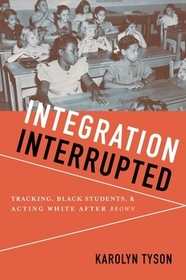
Integration Interrupted
Tracking, Black Students, and Acting White after Brown
- Publisher's listprice GBP 36.49
-
17 433 Ft (16 602 Ft + 5% VAT)
The price is estimated because at the time of ordering we do not know what conversion rates will apply to HUF / product currency when the book arrives. In case HUF is weaker, the price increases slightly, in case HUF is stronger, the price goes lower slightly.
- Discount 10% (cc. 1 743 Ft off)
- Discounted price 15 689 Ft (14 942 Ft + 5% VAT)
Subcribe now and take benefit of a favourable price.
Subscribe
17 433 Ft

Availability
printed on demand
Why don't you give exact delivery time?
Delivery time is estimated on our previous experiences. We give estimations only, because we order from outside Hungary, and the delivery time mainly depends on how quickly the publisher supplies the book. Faster or slower deliveries both happen, but we do our best to supply as quickly as possible.
Product details:
- Publisher OUP USA
- Date of Publication 3 March 2011
- ISBN 9780199736454
- Binding Paperback
- No. of pages240 pages
- Size 231x155x17 mm
- Weight 318 g
- Language English
- Illustrations 5 black and white line illustrations 0
Categories
Short description:
Integration Interrupted focuses on the consequences, particularly for black students, of the practice of curriculum tracking in the post-Brown era, and on the relationship between racialized tracking and the emergence of academic excellence as a "white thing," or acting white.
MoreLong description:
There is lots of popular and scholarly concern today about why black students aren't doing better in school. The most popular explanation, the "acting white" thesis, is that they have a culture that rejects achievement--that students' peer cultures hold them back. As Karolyn Tyson convincingly demonstrates, that is not the main or even a central explanation of black academic underachievement. Instead of looking at the students, Tyson argues that when and where students understand race to be connected with achievement, it is a powerful, if indirect, lesson conveyed by schools.
Integration Interrupted focuses on the consequences, particularly for black students, of the practice of curriculum tracking in the post-Brown era, and on the relationship between racialized tracking and the emergence of academic excellence as a "white thing." Desegregation may have been officially outlawed over fifty years ago, but race now determines which classes students are in: black students are typically placed in general and remedial classes and whites in advanced classes. In effect, same school, but different schooling. Right after Brown, it was easy to see the deliberate use of tracking to separate kids in schools that courts had mandated integrated. The practice still exists in many schools, though perhaps exercised more subtly, but with same outcome-tracking, including gifted and magnet programs, contributes to distinct racial patterns in achievement. Through ten years of classroom observations and hundreds of interviews with students, parents, and school personnel in thirty schoools, Tyson found that only in very specific circumstances, when black students were drastically underrrepresented in advanced and gifted classes, did anxieties about "the burden of acting white" emerge. But "acting white" is not the only nor the most important consequence of tracking for black students. Tyson reveals how the practice influences high achieving black students' conceptions of racial identity, achievement, and getting ahead; what courses they enroll in, who their friends are, and how they navigate peer pressure with being studious. In short, they face many of the same challenges as white youths face but with significant additional burdens.
The rich narratives on the lived experience of black students in Integration Interrupted throw light on the complex relationships underlying the academic performance of black students and convincingly demonstrates that the problem lies not with students, but instead with how we organize our schools.
Integration Interrupted is a masterpiece. In this beautifully written and meticulously researched book, Karolyn Tyson's close examination of how our schools are implicated in the creation of oppositional culture among all students, white as well as black, should occasion a major rethinking among scholars and policymakers about the mechanisms and processes that produce racial inequality in American education.
Table of Contents:
Preface
Acknowledgements
Introduction: Desegregation without Integration
Everyday Experience, Culture, and Acting White
Becoming a Cultural Object: Academic Achievement and Acting White among Black Students
Susceptibility to Oppositional Peer Cultures
Belonging: Course Selection and Race in the Age of Laissez Faire Tracking
Conclusion: Restoring the Promise of Brown
Notes
References
Index

