

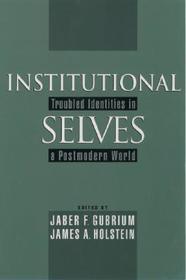
Institutional Selves
Troubled Identities in a Postmodern World
- Publisher's listprice GBP 36.99
-
16 700 Ft (15 905 Ft + 5% VAT)
The price is estimated because at the time of ordering we do not know what conversion rates will apply to HUF / product currency when the book arrives. In case HUF is weaker, the price increases slightly, in case HUF is stronger, the price goes lower slightly.
- Discount 10% (cc. 1 670 Ft off)
- Discounted price 15 030 Ft (14 315 Ft + 5% VAT)
Subcribe now and take benefit of a favourable price.
Subscribe
16 700 Ft

Availability
Uncertain availability. Please turn to our customer service.
Why don't you give exact delivery time?
Delivery time is estimated on our previous experiences. We give estimations only, because we order from outside Hungary, and the delivery time mainly depends on how quickly the publisher supplies the book. Faster or slower deliveries both happen, but we do our best to supply as quickly as possible.
Product details:
- Publisher OUP USA
- Date of Publication 21 September 2000
- ISBN 9780195129281
- Binding Paperback
- No. of pages208 pages
- Size 234x154x11 mm
- Weight 363 g
- Language English 0
Categories
Short description:
Institutional Selves highlights the process of self construction in a wide variety of institutional settings that contend with social and personal troubles. These organisations are virtually in the business of constructing the selves they need to do their work. From the victims and villains of televison talk shows, to battered women in support groups, to the violent selves of prison inmates, the book illustrates how selves are organizationally informed and
structured in today's world.
Long description:
Today, identities are conferred and selves are constructed in more organizational settings than ever before. Institutions large and small - from Psychiatric hospitals, schools, and prisons, to job clinics, counselling centres, support groups - virtually instruct us about who and what we are as part of the work they do in processing lives and personal troubles.
Some see this negatively, as if the self might somehow escape these developments. But there is a more balanced view that acknowledges the socially practical self we live by, which is constructed in light of these new and diverse opportunities. If organizations inevitably shape selves in today's world, they do so by providing the resources, not just the constraints, that enter into the process. New institutions produce new forms of self by presenting new options for who and what we
are and can be, while they also place practical limits on the range of possible identities. This is the leading theme of Institutional Selves. The book brings together nine distinctive chapters that collectively address the institutional construction of troubled selves. From the victims and villains of
television talk shows, to battered women in support groups, to the violent selves of prison inmates, the chapters show how personal identity is structured in response to the pragmatic demands of everyday life in the ubiquitous settings where personal troubles are under increasing consideration.

