

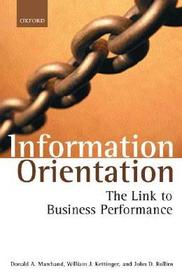
Information Orientation
The Link to Business Performance
- Publisher's listprice GBP 71.00
-
32 056 Ft (30 530 Ft + 5% VAT)
The price is estimated because at the time of ordering we do not know what conversion rates will apply to HUF / product currency when the book arrives. In case HUF is weaker, the price increases slightly, in case HUF is stronger, the price goes lower slightly.
- Discount 10% (cc. 3 205 Ft off)
- Discounted price 28 851 Ft (27 477 Ft + 5% VAT)
Subcribe now and take benefit of a favourable price.
Subscribe
32 056 Ft

Availability
printed on demand
Why don't you give exact delivery time?
Delivery time is estimated on our previous experiences. We give estimations only, because we order from outside Hungary, and the delivery time mainly depends on how quickly the publisher supplies the book. Faster or slower deliveries both happen, but we do our best to supply as quickly as possible.
Product details:
- Publisher OUP Oxford
- Date of Publication 11 January 2001
- ISBN 9780199240678
- Binding Hardback
- No. of pages328 pages
- Size 241x162x22 mm
- Weight 617 g
- Language English
- Illustrations numerous figures 0
Categories
Short description:
The authors of this book have developed a clear and effective framework for evaluating IT strategies - Information Orientation. Information Orientation does this by determining the degree to which a company implements and realizes the synergies across three information capabilitiess - information behaviour and values; information management practices; and IT practices. The book combines a focus on business relevance with strong empirical research.
MoreLong description:
In today's fast-moving, e-commerce economy information is power. For years companies have been investing in IT, expecting to develop their ability to exploit the power of information and achieve better business performance. Frequently, a company's investment has been a cost with no clear payback–a competitive necessity rather than a strategic advantage. The authors have developed a clear and effective framework for evaluating IT strategies - Information Orientation. Information Orientation does this by determining the degree to which a company implements and realizes the synergies across three information capabilities: information behaviors and values; information management practices; and information technology practices. The book provides a thorough description of the dimensions of each of the capabilities, along with the analytical basis which validates the research finding that a company must integrate all three information capabilities as a precondition for achieving superior business performance.
The book presents the Information Orientation Dashboard as a diagnostic tool to measure and evaluate the stengths and weaknesses of a company's information capabilities. The book also identifies a new trend in the way in which senior managers think about achieving strategic priorities and future industry leadership with information.
The book contributes to a new area of management thinking by offering empirically-tested and statistically-validated theories, which will not only be of interest to academics, but will also carry great significance for the practitioner. For academic readers, this book presents a theory with supporting evidence and arguments for changing the way management, and in particular IT researchers, examine the roles of people, information, and IT in decision making and strategy implementation. For company managers, this book provides a new framework and business metric that challenges current mindsets and practices concerning how people, information, and IT can be managed to achieve business results.
Table of Contents:
Chapter 1: Managing People, Information, and IT to Improve Business Performance
Chapter 2: Evolution of Management Thinking and Practice about People, Information, and IT
Chapter 3: How Senior Managers Assess IT Practices and Business Maturity
Chapter 4: How Senior Managers Value Information Management Practices
Chapter 5: What Key Behaviours and Values Lead to Effective Information Use by People in Companies
Chapter 6: Discovering the Link between the Information Orientation of Senior Managers and Business Performance
Chapter 7: Senior Manager Expectations about Competing for Future Industry Leadership with Information
Chapter 8: Information Orientation: A New Business Metric of Effective Information Use in Companies
Chapter 9: Epilogue: Transforming Management Practice and Metrics in the Age of Information Capitalism
Appendix: The Study's Research Approach and Statistical Results

