

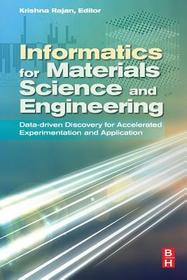
Informatics for Materials Science and Engineering
Data-driven Discovery for Accelerated Experimentation and Application
- Publisher's listprice EUR 149.00
-
61 797 Ft (58 855 Ft + 5% VAT)
The price is estimated because at the time of ordering we do not know what conversion rates will apply to HUF / product currency when the book arrives. In case HUF is weaker, the price increases slightly, in case HUF is stronger, the price goes lower slightly.
- Discount 10% (cc. 6 180 Ft off)
- Discounted price 55 618 Ft (52 970 Ft + 5% VAT)
Subcribe now and take benefit of a favourable price.
Subscribe
61 797 Ft

Availability
cancelled
Why don't you give exact delivery time?
Delivery time is estimated on our previous experiences. We give estimations only, because we order from outside Hungary, and the delivery time mainly depends on how quickly the publisher supplies the book. Faster or slower deliveries both happen, but we do our best to supply as quickly as possible.
Product details:
- Publisher Elsevier Science
- Date of Publication 30 October 2018
- ISBN 9780128101216
- Binding Paperback
- No. of pages542 pages
- Size 228x152 mm
- Weight 450 g
- Language English 0
Categories
Long description:
"
Materials informatics: a 'hot topic' area in materials science, aims to combine traditionally bio-led informatics with computational methodologies, supporting more efficient research by identifying strategies for time- and cost-effective analysis.
The discovery and maturation of new materials has been outpaced by the thicket of data created by new combinatorial and high throughput analytical techniques. The elaboration of this ""quantitative avalanche""-and the resulting complex, multi-factor analyses required to understand it-means that interest, investment, and research are revisiting informatics approaches as a solution.
This work, from Krishna Rajan, the leading expert of the informatics approach to materials, seeks to break down the barriers between data management, quality standards, data mining, exchange, and storage and analysis, as a means of accelerating scientific research in materials science.
This solutions-based reference synthesizes foundational physical, statistical, and mathematical content with emerging experimental and real-world applications, for interdisciplinary researchers and those new to the field.
" MoreTable of Contents:
Preface: A Reading Guide xiii
Acknowledgment xv
1. Materials Informatics: An Introduction 1
2. Data Mining in Materials Science and Engineering 17
3. Novel Approaches to Statistical Learning in Materials Science 37
4. Cluster Analysis: Finding Groups in Data 53
5. Evolutionary Data-Driven Modeling 71
6. Data Dimensionality Reduction in Materials Science 97
7. Visualization in Materials Research: Rendering Strategies
of Large Data Sets 121
8. Ontologies and Databases < Knowledge Engineering
for Materials Informatics 147
9. Experimental Design for Combinatorial Experiments 189
10. Materials Selection for Engineering Design 219
11. Thermodynamic Databases and Phase Diagrams 245
12. Towards Rational Design of Sensing Materials
from Combinatorial Experiments 271
13. High-Performance Computing for Accelerated Zeolitic
Materials Modeling 315
14. Evolutionary Algorithms Applied to Electronic-Structure
Informatics: Accelerated Materials Design Using Data
Discovery vs. Data Searching 349
15. Informatics for Crystallography: Designing Structure Maps 365
16. From Drug Discovery QSAR to Predictive Materials QSPR:
The Evolution of Descriptors, Methods, and Models 385
17. Organic Photovoltaics 423
18. Microstructure Informatics 443
19. Artworks and Cultural Heritage Materials: Using Multivariate
Analysis to Answer Conservation Questions 467
20. Data Intensive Imaging and Microscopy: A Multidimensional
Data Challenge 495
References 510
Index 513

