

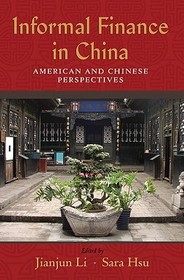
Informal Finance in China: American and Chinese Perspectives
- Publisher's listprice GBP 71.00
-
32 056 Ft (30 530 Ft + 5% VAT)
The price is estimated because at the time of ordering we do not know what conversion rates will apply to HUF / product currency when the book arrives. In case HUF is weaker, the price increases slightly, in case HUF is stronger, the price goes lower slightly.
- Discount 10% (cc. 3 206 Ft off)
- Discounted price 28 851 Ft (27 477 Ft + 5% VAT)
Subcribe now and take benefit of a favourable price.
Subscribe
32 056 Ft

Availability
printed on demand
Why don't you give exact delivery time?
Delivery time is estimated on our previous experiences. We give estimations only, because we order from outside Hungary, and the delivery time mainly depends on how quickly the publisher supplies the book. Faster or slower deliveries both happen, but we do our best to supply as quickly as possible.
Product details:
- Publisher OUP USA
- Date of Publication 1 October 2009
- ISBN 9780195380644
- Binding Hardback
- No. of pages216 pages
- Size 157x236x20 mm
- Weight 499 g
- Language English
- Illustrations 1 colour halftone, 8 black and white line illustrations 0
Categories
Short description:
Informal Finance in China is a compilation of chapters written by leading scholars on informal, or non-bank, finance in China. Presently there is a scarcity of information on informal finance in China, and yet by heavily interacting with bank financing and production, informal finance is estimated to have a significant impact upon GDP and the money supply. With China's financial power increasing in influence in the world economy, there is a growing need to elaborate on the workings of funding sources.
MoreLong description:
Informal finance consists of nonbank financing activities, whether conducted through family and friends, local money houses, or other types of financial associations. It has provided much-needed financing to small and medium enterprises (SMEs) in particular, in the face of a tightly constrained and overburdened formal banking system. Unable to obtain a bank loan, firms have relied upon individuals and informal organizations outside of the banking system to obtain financing for their ventures or working capital (operating funds). Presently there is a scarcity of information on informal finance in China and it is expected to have a significant impact upon GDP and money supply.
This book, with contributions from leading scholars, describes the evolution, characteristics, and variation of informal finance in China from American and Chinese perspectives. Literature by Jiang Shuxia, Jiang Xuzhao, and Li Jianjun has heretofore been available only in Chinese, while work by Kellee Tsai, Jianwen Liao, Harold Welsch, David Pistrui, and Sara Hsu has been available in English. For the first time, they come together to discuss informal financing and its many aspects.
Most of the essays are based upon original survey research conducted locally, as this type of data is not normally collected by the government. The papers pioneer the description and analysis of the nuances of informal finance from several perspectives; the authors look at the social, cultural, political, and economic causes of informal finance, its many variations, and its economic, personal, and political ramifications.
Informal financing has long caught the attention of academic circles as well as the wide public. However, the lack of in-depth and comprehensive study of the issue is as obvious as the phenomenon itself. Fortunately, this book now offers us an adequate and accurate analysis of the Chinese informal financing, by empirically tracing its evolution alongside the unfolding of the overall economic reform, and formulating theories based on actual cases from the field. The accomplishments of the book also owe a lot to the co-editors from both China and the United States, whose reputable contribution will certainly be appreciated by readers of this milestone work.
Table of Contents:
Sara Hsu, Introduction
: Shuxia Jiang, The Evolution of Informal Finance in China, and its Prospects
: Jianjun Li, Informal Finance, Underground Finance, Illegal Finance and Economic Movement: A National Analysis
Xuzhao Jiang, A Comparative Analysis of Regional Informal Financial Organizations in China
Kellee Tsai, Beyond Banks: The Local Logic of Informal Finance and Private Sector Development in China
: Jianwen Liao, Qian Ye, David Pistrui, and Harold P. Welsch: New Venture Financing: An Empirical Investigation of Chinese Entrepreneurs
: Sara Hsu, Is Informal Finance Faster, Cheaper, Better than Formal Finance? A Study of Small and Medium Enterprises in Shanghai and Nanjing
: Jianjun Li, Conclusion: Regulating Informal Finance in China
Appendix A: Qiang Fu & Jianjun Li, Informal Finance, Monetary Conditions and Economic Movements
Appendix B: Guangning Tian, The Story of One Entrepreneur's Financing Experience in Shanxi

