

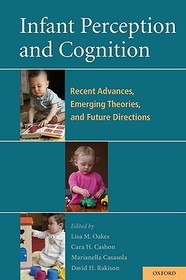
Infant Perception and Cognition
Recent Advances, Emerging Theories, and Future Directions
- Publisher's listprice GBP 98.00
-
44 247 Ft (42 140 Ft + 5% VAT)
The price is estimated because at the time of ordering we do not know what conversion rates will apply to HUF / product currency when the book arrives. In case HUF is weaker, the price increases slightly, in case HUF is stronger, the price goes lower slightly.
- Discount 10% (cc. 4 425 Ft off)
- Discounted price 39 822 Ft (37 926 Ft + 5% VAT)
Subcribe now and take benefit of a favourable price.
Subscribe
44 247 Ft

Availability
printed on demand
Why don't you give exact delivery time?
Delivery time is estimated on our previous experiences. We give estimations only, because we order from outside Hungary, and the delivery time mainly depends on how quickly the publisher supplies the book. Faster or slower deliveries both happen, but we do our best to supply as quickly as possible.
Product details:
- Publisher OUP USA
- Date of Publication 23 September 2010
- ISBN 9780195366709
- Binding Hardback
- No. of pages312 pages
- Size 163x236x25 mm
- Weight 596 g
- Language English
- Illustrations 9 color lineart, 38 BW lineart, 10 color halftone, 1 BW halftone, 3 color combo 0
Categories
Long description:
The cognitive revolution in the 1950s and 1960s led researchers to view the human mind--like a computer--as an information-processing system that encodes, represents, and stores information and is constrained by limits on hardware (the brain) and software (learning strategies and rules). The emergence of new behavioral, computational, and neuroscience methodologies, has deeply expanded psychologists' understanding of the workings of the infant, child, and adult mind. One result is that research has focused on mechanisms of change, over developmental time, in the information-processing mind.
In this book, Lisa Oakes, Cara Cashon, Marianella Casasola, and David Rakison bring together the recent findings and theories about the origins and early development of the information-processing mind, and provide insight into the future directions in the study of infant perception and cognition. The contributors represent a wide-range of research areas in the study of infant perception and cognition, who emphasize the use of diverse methodological techniques to address key questions about development. Their chapters demonstrate how the combination of historical perspectives on the information-processing approach to cognition and recent advances in behavioral, computational, and neuroscience approaches to cognition has contributed to our understanding of how abilities ranging from visual attention to face processing to object categorization have developed during infancy. Across this broad range of topics, it is clear that much of our modern understanding of infant perceptual and cognitive development emerges from the foundation of classic information-processing models of development, such as that of Leslie B. Cohen (1991). The recent advances illustrated in this book show how researchers have built on this foundation to uncover the mechanisms that drive developmental change.
This book ... gives us an excellent understanding of where we have been and a guide for exploring our future in the context of a very strong theoretical framework; it is a distinctive contribution to the literature.

