

- Publisher's listprice GBP 71.00
-
33 920 Ft (32 305 Ft + 5% VAT)
The price is estimated because at the time of ordering we do not know what conversion rates will apply to HUF / product currency when the book arrives. In case HUF is weaker, the price increases slightly, in case HUF is stronger, the price goes lower slightly.
- Discount 10% (cc. 3 392 Ft off)
- Discounted price 30 528 Ft (29 075 Ft + 5% VAT)
Subcribe now and take benefit of a favourable price.
Subscribe
33 920 Ft

Availability
printed on demand
Why don't you give exact delivery time?
Delivery time is estimated on our previous experiences. We give estimations only, because we order from outside Hungary, and the delivery time mainly depends on how quickly the publisher supplies the book. Faster or slower deliveries both happen, but we do our best to supply as quickly as possible.
Product details:
- Publisher OUP USA
- Date of Publication 31 May 2012
- ISBN 9780199915187
- Binding Hardback
- No. of pages312 pages
- Size 163x236x20 mm
- Weight 587 g
- Language English
- Illustrations 35 illustrations 0
Categories
Short description:
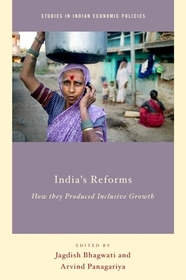
The essays in this first volume in the series Studies in Indian Economic Policies show that trade openness has helped reduce poverty among most social groups including the Scheduled Castes. Openness has affected neither poverty nor inequality adversely. When surveyed, people in disproportionately large volumes from all groups say that their fortunes are improving. This is also reflected in election outcomes with the governments delivering good economic outcomes winning and the others losing.
MoreLong description:
When India embraced systematic economic reforms in 1991 and began opening its economy to both domestic and foreign competition, critics argued that they had contributed little to the acceleration of economic growth. Their argument had rested on the claim that growth in the 1990s was no faster than in the 1980s. This claim was quickly refuted on the grounds that when properly evaluated, growth had indeed accelerated in the 1990s and, more importantly, while reforms had been made systematic in 1991, they had actually begun much earlier in the late 1970s. Subsequently, the reforms of the late 1990s and early 2000s have led to a jump in the growth rate from six percent in the 1990s to eight to nine percent beginning in 2003. The reforms have also led to a major structural change in the economy: the trade to GDP ratio tripled since 1991, there has been a gigantic expansion of foreign investment in India, and sectors such as telecommunications, airlines, and automobiles have expanded at rates much higher than those observed any time in the past. This dramatic turn-around has led the critics to shift ground. They now argue that opening the economy to trade has hurt the poor; that rapid growth is leaving the socially disadvantaged groups behind; and that the reforms have led to increased inequality. They also argue that people themselves do not feel that their fortunes are improving.
The five original essays in this volume, topped by a substantial introductory essay summarizing their findings, take these challenges head on. They use large-scale sample surveys and other data to systematically address each of these arguments. They show that trade openness has indeed helped reduce poverty not just in general but also among the socially disadvantaged groups. The contributors to the volume find no evidence whatsoever in favor of a negative impact of trade openness on poverty on any groups. The essays also show that inequality shows no clear trend and is unrelated to trade openness. Peoples responses have also now turned grossly in favor of reforms. Thus, when asked how they feel about the change in their fortunes in the recent past, an overwhelmingly large proportion of individuals from every conceivable group report improvements. Moreover, systematic analysis of the 2009 parliamentary elections show that people now reward the Chief Ministers in states in which they deliver superior growth outcomes and punish those that do not.
This book is the first volume in the series Studies in Indian Economic Policies edited by Jagdish Bhagwati and Arvind Panagariya and published by OUP. It contains the first set of five original papers produced under the auspices of the Columbia Program on Indian Economic Policies housed in the School of International and Public Affairs (SIPA) and the Institute for Social and Economic Research and Policy (ISERP).
a major empirical contribution.
Table of Contents:
1. Introduction
Jagdish Bhagwati and Arvind Panagariya
Part I: Reforms and Democracy
2. Views from the Indian Electorate: Satisfactions and Dissatisfactions with Democracy, Politics and the Economy
Alfred Stepan
3. Economic Reforms and Electoral Outcomes
Poonam Gupta and Arvind Panagariya
Part II: Trade, Poverty and Inequality
4. Trade Liberalization and Poverty Reduction: New Evidence from Indian States
J. Cain, Rana Hasan and Devashish Mitra
5. Growth, Openness and the Socially Disadvantaged
Megha Mukim and Arvind Panagariya
6. Trade and Inequality in India
Pravin Krishna, Guru Sethupathy

