

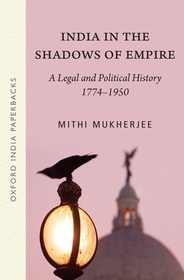
India in the Shadows of Empire
A Legal and Political History (1774-1950)
- Publisher's listprice GBP 12.99
-
5 864 Ft (5 585 Ft + 5% VAT)
The price is estimated because at the time of ordering we do not know what conversion rates will apply to HUF / product currency when the book arrives. In case HUF is weaker, the price increases slightly, in case HUF is stronger, the price goes lower slightly.
- Discount 10% (cc. 586 Ft off)
- Discounted price 5 278 Ft (5 027 Ft + 5% VAT)
Subcribe now and take benefit of a favourable price.
Subscribe
5 864 Ft

Availability
Only to order.
Why don't you give exact delivery time?
Delivery time is estimated on our previous experiences. We give estimations only, because we order from outside Hungary, and the delivery time mainly depends on how quickly the publisher supplies the book. Faster or slower deliveries both happen, but we do our best to supply as quickly as possible.
Product details:
- Publisher OUP India
- Date of Publication 22 March 2012
- ISBN 9780198079439
- Binding Paperback
- No. of pages316 pages
- Size 216x138x16 mm
- Weight 292 g
- Language English 0
Categories
Short description:
This book offers a comprehensive new interpretation of the complex and seemingly contradictory nature of Indian democracy and polity. It explains the postcolonial Indian polity by presenting an alternative historical narrative of the British Empire in India and India's struggle for independence.
MoreLong description:
This pioneering research offers a sweeping new interpretation of the complex and seemingly contradictory nature of Indian democracy and polity. In contrast to much of existing scholarship, it joins the colonial and postcolonial periods in Indian history into a seamless narrative. This book explains the postcolonial Indian polity by presenting an alternative historical narrative of the British Empire in India and India's struggle for Independence. It pursues this narrative along two major trajectories. On the one hand, it focuses on the role of imperial judicial institutions and practices in the making of both the British Empire and the anti-colonial movement under the Congress, with the lawyer as political leader. On the other hand, it offers a novel interpretation of Gandhi's non-violent resistance movement as being different from the Congress. It shows that the Gandhian movement, as the most powerful force largely responsible for India's Independence, was anchored not in western discourses of political and legislative freedom but rather in Indian traditions of renunciative freedom, with the renouncer as leader.
This book would be of considerable interest to students and scholars of law, modern Indian history, and political science. It will also have a significant general appeal.
Table of Contents:
Acknowledgements
Introduction
The Colonial and the Imperial: India and Britain in the Impeachment Trial of Warren Hastings;
Conflict of Sovereignty: The Judiciary, the Executive, and the Emergence of the Indian Legislative Council as a Court of Law;
Into the Labyrinth: The Birth of Justice as a Discourse of Governance;
'Vakil Raj': The Indian National Congress and the Birth of the Lawyer as Political Representative;
From Imperial Justice to Transcendental Freedom: The Samnyasin as Leader in the Movement for National Independence;
An Imperial Constitution? Justice as Equity and the Making of the Indian Constitution;
India after Independence: A Tale of Conflicting Legacies;
Bibliography
Index

