

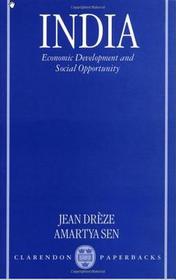
India: Economic Development and Social Opportunity
- Publisher's listprice GBP 105.00
-
47 407 Ft (45 150 Ft + 5% VAT)
The price is estimated because at the time of ordering we do not know what conversion rates will apply to HUF / product currency when the book arrives. In case HUF is weaker, the price increases slightly, in case HUF is stronger, the price goes lower slightly.
- Discount 10% (cc. 4 740 Ft off)
- Discounted price 42 667 Ft (40 635 Ft + 5% VAT)
Subcribe now and take benefit of a favourable price.
Subscribe
47 407 Ft

Availability
printed on demand
Why don't you give exact delivery time?
Delivery time is estimated on our previous experiences. We give estimations only, because we order from outside Hungary, and the delivery time mainly depends on how quickly the publisher supplies the book. Faster or slower deliveries both happen, but we do our best to supply as quickly as possible.
Product details:
- Publisher Clarendon Press
- Date of Publication 4 April 1996
- ISBN 9780198290124
- Binding Hardback
- No. of pages306 pages
- Size 225x145x23 mm
- Weight 515 g
- Language English
- Illustrations frontispiece, line figures, tables 0
Categories
Short description:
Two prominent economists argue that public involvement is required in the provision of basic health care, education, and social security if economic and social advances are to be made in India. This analysis of the endemic deprivation in India is based on a broad view of economic development, focusing on human well-being and `social opportunity' rather than on the standard indicators of economic growth. India's economic successes and failures are evaluated in the light of other countries' development experiences.
MoreLong description:
An analysis of endemic deprivation in India and of the role of public action in addressing that problem. The analysis is based on a broad view of economic development, focusing on human well-being and `social opportunity' rather than on the standard indicators of economic growth.
India's success in reducing endemic deprivation since Independence has been quite limited. Recent diagnoses of this failure of policy have concentrated on the counterproductive role of government regulation, and on the need for economic incentives to accelerate the growth of the economy. This book argues that an assessment of India's failure to eliminate basic deprivations has to go beyond this limited focus, and to take note of the role played in that failure by inadequate public involvement in the provision of basic education, health care, social security, and related fields, Even the fostering of fast and participatory economic growth requires some basic social change, which is not addressed by liberalization and economic incentives. The authors also discuss the historical antecedents of these political and social neglects, including the distortion of policy priorities arising from inequalities of political power. Following on from this, the book considers the scope for public action to address these earlier biases and achieve a transformation of policy priorities.
The introductory chapter presents the motivation, focus, and approach of the book. Chapter 2 discusses the respective roles of the market mechanism and government action in economic development and discusses the particular role of public involvement in the fields of health and education. In chapters 3 and 4, international comparisons of development experiences are brought to bear on the diagnosis of India's successes and failures. These two chapters also discuss the lessons to be learnt from the contrasting development experiences of different states within India, with particular attention to Kerala's outstanding success in social fields. Chapter 5 considers the role of public action and political organization in promoting social opportunities. Attention is drawn, in particular, to the part played by widespread illiteracy in suppressing that process and perpetuating social inequalities. The issue of basic education is further examined in chapter 6, which includes a critical assessment of public policy in this field. Chapter 7 discusses the specific problem on gender inequality, and the role of women's agency in the expansion of social opportunities for both women and men. The concluding chapter consolidates the argument and discusses the policy implication of the analyses presented. A statistical appendix presents a comparative picture of India and other developing countries, and also the comparative performance of different states within India.
As a compendium of data on India's education system and, to a lesser extent its record on eliminating basic health problems and gender inequality, the book is without recent peer.

