

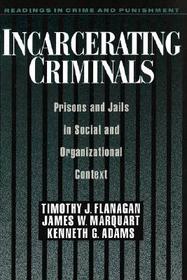
Incarcerating Criminals
Prisons and Jails in Social and Organizational Context
Series: Readings in Crime and Punishment;
- Publisher's listprice GBP 35.00
-
16 721 Ft (15 925 Ft + 5% VAT)
The price is estimated because at the time of ordering we do not know what conversion rates will apply to HUF / product currency when the book arrives. In case HUF is weaker, the price increases slightly, in case HUF is stronger, the price goes lower slightly.
- Discount 10% (cc. 1 672 Ft off)
- Discounted price 15 049 Ft (14 333 Ft + 5% VAT)
Subcribe now and take benefit of a favourable price.
Subscribe
16 721 Ft

Availability
Uncertain availability. Please turn to our customer service.
Why don't you give exact delivery time?
Delivery time is estimated on our previous experiences. We give estimations only, because we order from outside Hungary, and the delivery time mainly depends on how quickly the publisher supplies the book. Faster or slower deliveries both happen, but we do our best to supply as quickly as possible.
Product details:
- Publisher OUP USA
- Date of Publication 1 April 1999
- ISBN 9780195105414
- Binding Paperback
- No. of pages352 pages
- Size 234x156x16 mm
- Weight 491 g
- Language English 0
Categories
Short description:
This text is part of the Readings in Crime and Punishment series, a line of readers covering many aspects of the criminal justice, police, and correctional systems. Incarcerating Criminals look at our prisons and jails, situating them in their social and institutional environments. It will be an ideal text for advanced undergraduate and graduate level courses in criminal justice and criminology, sociology, public policy, and other disciplines looking at our
correctional institutions.
Long description:
Incarcerating Criminals places prisons and jails in the context of their social and organizational environments, examining these modern day correctional institutions and the issues and trends surrounding them. Selections provide historical and contemporary perspectives and data on the institutions themselves, their origins and development, and current controversies such as overcrowding, substance abuse treatment, and health care. Understanding why prisons
are built when they are, where they are, and administered as they are requires students to appreciate the inextricable links between these institutions, the rest of the criminal justice system, and the social and political atmosphere that supports them. Incarcerating Criminals offers students a better
understanding of the reasons for developing prisons and jails and the premises underlying contemporary correctional operations and crime control proposals. A special section focuses on specific inmate groups, from mentally ill offenders to those suffering from AIDS, to female inmates and gang members, to the correctional staff themselves. The concluding section examines the future of jails and prisons, including such current issues as privatization, risk management, and technological advances
that affect corrections. Edited by three of the leading scholars in the field, Incarcerating Criminals is essential for advanced undergraduate and graduate level courses in criminal justice, criminology, sociology, and public policy, and for those individuals interested in learning more about
correctional institutions.
A most useful section (not often found in books on penality) deals with some of the issues specifically constituted within, and circumscribed by, 'the legal environment of incarceration'. The collection edited by Flanagan et al is important in its own right because of the breadth of the range of prison topics discussed. It should appeal not only to academic students of penality but also to criminal justice and prisons personnel interested in a range of
administrative issues ... it could also provide ... students with a convenient collection of some of the most signficant essays on penality by theorists ... as well as giving them a taste of some important perspectives which need to be appreciated because of the ways in which they have influnenced, and continue
to influence, the development of both American and British penal institutions and penal politics.
Table of Contents:
Preface
CHAPTER 1. THE ROLE OF PUNISHMENT AND THE DEVELOPMENT OF INCARCERATION
The Disappearance of Public Executions
The Historical Origins of the Sanction of Imprisonment for Serious Crime
The Invention of the Penitentiary
Complete and Austere Institutions
Prisons for Women, 1790-1980
CHAPTER 2. THE LEGAL ENVIRONMENT OF INCARCERATION
The Legacy and Future of Corrections Litigation
Prisons: The Cruel and Unusual Punishment Controversy
Judicial Reform and Prisoner Control: The Impact of Ruiz v. Estelle on a Texas Penitentiary
Judicial Intervention: Lessons from the Past
CHAPTER 3. CONTEMPORARY CORRECTIONAL INSTITUTIONS AS PEOPLE PROCESSING ORGANIZATIONS
A Prison Superintendent's Perspective on Women in Prison
The Special Management Inmate
Prison Violence: A Scottish Perspective
Changes in Prison Culture: Prison Gangs and the Case of the "Pepsi Generation"
The Brother's Keeper: A Review of the Literature on Correctional Officers
Organizational Barriers to Women Working as Corrections Officers in Men's Prisons
The Prison as a Constitutional Government
CHAPTER 4. CONTEMPORARY PRISONS AS PROCESS: CORRECTIONAL INTERVENTION
HIV in Prisons
AIDS Recommendations and Prisons in Australia
Tuberculosis in Correctional Facilities
Classification for Control in Jails and Prisons
Effective Treatment for Drug and Alcohol Problems: What Do We Know?
A Full Employment Policy for Prisons in the United States: Some Arguments, Estimates, and Implications
Literacy Training and Reintegration of Offenders
Effective Correctional Programming: What Empirical Research Tells Us and What It Doesn't
Discipline
CHAPTER 5 THE MODERN JAIL
Prison and Jail Inmates at Midyear 1996
The Jail
Who Is in Jail? An Examination of the Rabble Hypothesis
The Jail and the Community
CHAPTER 6. FUTURE ISSUES AND TRENDS
Criminal Justice Performance Measures for Prisons
Public Imprisonment by Private Means: The Re-emergence of Private Prisons and Jails in the United States, the United Kingdom, and Australia
Racial Disproportion in U.S. Prisons
What Not to Do About Crime — The American Society of Criminology 1994 Presidential Address
The Bull Market in Corrections
The Future of the Penitentiary

