

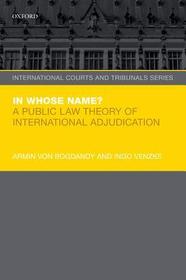
In Whose Name?
A Public Law Theory of International Adjudication
Series: International Courts and Tribunals Series;
- Publisher's listprice GBP 54.00
-
25 798 Ft (24 570 Ft + 5% VAT)
The price is estimated because at the time of ordering we do not know what conversion rates will apply to HUF / product currency when the book arrives. In case HUF is weaker, the price increases slightly, in case HUF is stronger, the price goes lower slightly.
- Discount 10% (cc. 2 580 Ft off)
- Discounted price 23 219 Ft (22 113 Ft + 5% VAT)
Subcribe now and take benefit of a favourable price.
Subscribe
25 798 Ft

Availability
printed on demand
Why don't you give exact delivery time?
Delivery time is estimated on our previous experiences. We give estimations only, because we order from outside Hungary, and the delivery time mainly depends on how quickly the publisher supplies the book. Faster or slower deliveries both happen, but we do our best to supply as quickly as possible.
Product details:
- Publisher OUP Oxford
- Date of Publication 10 March 2016
- ISBN 9780198784418
- Binding Paperback
- No. of pages326 pages
- Size 232x156x17 mm
- Weight 490 g
- Language English 0
Categories
Short description:
International courts and tribunals make decisions which shape international law. Yet what grants them the legitimacy to make these decisions in the first place? This book proposes a theory of international public law that argues that these international courts democratically derive their legitimacy from the people and citizens.
MoreLong description:
The vast majority of all international judicial decisions have been issued since 1990. This increasing activity of international courts over the past two decades is one of the most significant developments within the international law. It has repercussions on all levels of governance and has challenged received understandings of the nature and legitimacy of international courts. It was previously held that international courts are simply instruments of dispute settlement, whose activities are justified by the consent of the states that created them, and in whose name they decide. However, this understanding ignores other important judicial functions, underrates problems of legitimacy, and prevents a full assessment of how international adjudication functions, and the impact that it has demonstrably had.
This book proposes a public law theory of international adjudication, which argues that international courts are multifunctional actors who exercise public authority and therefore require democratic legitimacy. It establishes this theory on the basis of three main building blocks: multifunctionality, the notion of an international public authority, and democracy. The book aims to answer the core question of the legitimacy of international adjudication: in whose name do international courts decide? It lays out the specific problem of the legitimacy of international adjudication, and reconstructs the common critiques of international courts. It develops a concept of democracy for international courts that makes it possible to constructively show how their legitimacy is derived. It argues that ultimately international courts make their decisions, even if they do not know it, in the name of the peoples and the citizens of the international community.
The expansive growth and influence of international courts, tribunals, and quasi-judicial bodies (ICTs) fuels well deserved interest across disciplines far beyond public international law, including political science and political philosophy. How are we to describe, explain, and assess this partial abdication of sovereignty by the main actors of a (formerly) state-centric world order? Armin von Bogdandy and Ingo Venzke have again joined forces to illuminate these profound issues of the functions and legitimacy of ICTs, tying together and expanding on previous valuable insights.
Table of Contents:
Postscript to the Paperback Edition
Agenda and objectives
Basic conceptions of international courts
Key elements of a public law theory of adjudication
Pathways of democratic legitimacy
In whose name?

