

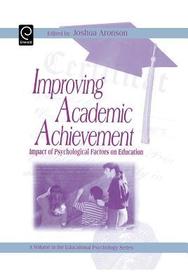
Improving Academic Achievement
Impact of Psychological Factors on Education
Series: Educational Psychology;
- Publisher's listprice GBP 78.99
-
35 663 Ft (33 965 Ft + 5% VAT)
The price is estimated because at the time of ordering we do not know what conversion rates will apply to HUF / product currency when the book arrives. In case HUF is weaker, the price increases slightly, in case HUF is stronger, the price goes lower slightly.
35 663 Ft

Availability
printed on demand
Why don't you give exact delivery time?
Delivery time is estimated on our previous experiences. We give estimations only, because we order from outside Hungary, and the delivery time mainly depends on how quickly the publisher supplies the book. Faster or slower deliveries both happen, but we do our best to supply as quickly as possible.
Product details:
- Publisher Academic Press Inc
- Date of Publication 15 April 2002
- ISBN 9780120644551
- Binding Hardback
- No. of pages395 pages
- Size 229x152x25 mm
- Weight 743 g
- Language English 0
Categories
Short description:
What motivates us to direct our behaviors toward certain goals? To what extent can rewards and/or punishments induce us toward and away from specific actions? This title provides a summary overview of research in this area as well as a forward look into the future of research.
MoreLong description:
Social psychological research has revealed much about how personal and interpersonal factors impact academic achievement. The research has been reported in several different outlets but has never before been condensed in an easy to read, engaging book, targeting the hot topics of coffee table debates. This book does just that, offering review chapters by the most influential researchers of today, written for an audience of educational and cognitive psychologists as well as school administrators, teachers, policy makers, and parents. Section one focuses on what motivates students, how self-esteem affects the learning process, the consequences of achievement goals, the effects of student attributions of success and failure, self-handicapping, methods of strategic learning, and how to successfully use one's intelligence. Section two discusses how the offering of rewards may affect achievement, how teacher expectations may affect student performance, the effects of stereotypes, feedback, and social rejection. There's also a discussion of effective means of turning at-risk students into scholars, and how students can successfully traverse transitions to middle school.
MoreTable of Contents:
Contributors. A.J. Elliott, Foreword. Preface. Acknowledgements. Part One: Introductory Chapter: F. Pajares and D.H. Schunk, Self and Self-Belief in Psychology and Education: A Historical Perspective. Part Two: Revisiting and Extending Classic Lessons: R. Rosenthal, The Pygmalion Effect and its Mediating Mechanisms. C.S. Dweck, Messages That Motivate: How Praise Molds Students' Beliefs, Motivation, and Perfrmance (In Surprising Ways). E.L. Deci and R.M. Ryan, The Paradox of Achievement: The Harder you Push, the Worse it Gets. T.D. Wilson, M. Damiani, and N. Shelton, Improving the Academic Performance of College Students with Brief Attributional Interventions. F. Rhodewalt and M.W. Tragakis, Self-Handicapping and School: On Academic Self-Concept and Self-Protective Behavior. M.R. Lepper and M. Woolverton, The Wisdom of Practice: Lessons Learned from the Study of Highly Effective Tutors. A. Wigfield and J.S. Eccles, Students' Motivation During the Middle School years. P.J. Gaskill and A.W. Hoy, Self-Efficacy and Self-Regulated Learning: The Dynamic Duo in School Performance. E. Aronson, Building Empathy, Compassion and Achievement in the Jigsaw Classroom. R.J. Sternberg, Intelligence is not Just Inside the Head: The Theory of Successful Intelligence. Part Three: Current Lessons: D.A. Pizarro and P. Salovey, Being and Becoming a Good Person: The Role of Emotional Intelligence in Moral Development and Behavior. F.H. Rauscher, Mozart and the Mind: Factual and Fictional Effects of Musical Enrichment. J. Aronson, Stereotype Threat: Contending and Coping with Unnerving Expectations. G.L. Cohen and C.M. Steele, A Barrier of Mistrust: How Negative Stereotypes Affect Cross-Race Mentoring. A.R. Pratkanis, M.E. Turner, and S.B. Malos, Towards a Resolution of an American Tension: Some Applications of the Helping Model of Affirmative Action in Schooling. A.W. Harrist and K.D. Bradley, Social Exclusion in the Classroom: Teachers and Students as Agents of Change. Index.
More
