

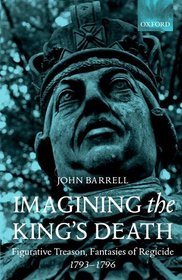
Imagining the King's Death
Figurative Treason, Fantasies of Regicide, 1793-1796
- Publisher's listprice GBP 250.00
-
112 875 Ft (107 500 Ft + 5% VAT)
The price is estimated because at the time of ordering we do not know what conversion rates will apply to HUF / product currency when the book arrives. In case HUF is weaker, the price increases slightly, in case HUF is stronger, the price goes lower slightly.
- Discount 10% (cc. 11 288 Ft off)
- Discounted price 101 588 Ft (96 750 Ft + 5% VAT)
Subcribe now and take benefit of a favourable price.
Subscribe
112 875 Ft

Availability
printed on demand
Why don't you give exact delivery time?
Delivery time is estimated on our previous experiences. We give estimations only, because we order from outside Hungary, and the delivery time mainly depends on how quickly the publisher supplies the book. Faster or slower deliveries both happen, but we do our best to supply as quickly as possible.
Product details:
- Publisher OUP Oxford
- Date of Publication 16 March 2000
- ISBN 9780198112921
- Binding Hardback
- No. of pages756 pages
- Size 244x165x46 mm
- Weight 1417 g
- Language English
- Illustrations 24 black and white halftones 0
Categories
Short description:
It is high treason in British law to imagine the king's death. But after the execution of Louis XVI in 1793, everyone in Britain must have found themselves imagining that the same fate might befall George III. How easy was it to distinguish between fantasising about the death of George and 'imagining' it, in the legal sense of 'intending' or 'designing'?
MoreLong description:
It is high treason in British law to 'imagine' the king's death. But after the execution of Louis XVI in 1793, everyone in Britain must have found themselves imagining that the same fate might befall George III. How easy was it to distinguish between fantasising about the death of George and 'imagining' it, in the legal sense of 'intending' or 'designing'? John Barrell examines this question in the context of the political trials of the mid-1790s and the controversies they generated. He shows how the law of treason was adapted in the years following Louis's death to punish what was acknowledged to be a 'modern' form of treason unheard of when the law had been framed. The result, he argues, was the invention of a new, an imaginary, a 'figurative' treason, by which the question of who was imagining the king's death, the supposed traitors or those who charged them with treason, became inescapable.
John Barrell's book crosses the boundaries between literary criticism and history. It throws light not just upon the changing use of language and its deployment, but on the operation of the law in the 18th century, the use of propaganda, the exercise of state power and the ability of opponents of government both to defend themselves and to attack their oppressors.
Table of Contents:
Introduction
Part One: Sad Stories
The Last Interview
'When Kings Are Hurled From Their Thrones'
Part Two: The Invention of Modern Treason
Convention and Conspiracy
The British Convention
The Trial of Thomas Walker
Secret Committees
The Arming of the L.C.S.
Parliament and Prejudication
The Trials of Watt and Downie
The Charge to the Grand Jury
The Trial of Thomas Hardy
The Trials of Tooke and Thelwall
'A Conspiracy without Conspirators'
Part Three: Alarms and Diversions
The Pop-Gun Plot
Traitor or Lunatic: The Arrest of Richard Brothers
Part Four: Phantoms of Imagination
The Treasonable Practices Act
King Killing
Epilogue: 'Fire, Famine, And Slaughter'
Appendix
Notes
Bibliography
Index

