

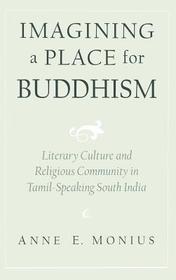
Imagining a Place for Buddhism
Literary Culture and Religious Community in Tamil-Speaking South India
- Publisher's listprice GBP 135.00
-
60 952 Ft (58 050 Ft + 5% VAT)
The price is estimated because at the time of ordering we do not know what conversion rates will apply to HUF / product currency when the book arrives. In case HUF is weaker, the price increases slightly, in case HUF is stronger, the price goes lower slightly.
- Discount 10% (cc. 6 095 Ft off)
- Discounted price 54 857 Ft (52 245 Ft + 5% VAT)
Subcribe now and take benefit of a favourable price.
Subscribe
60 952 Ft

Availability
printed on demand
Why don't you give exact delivery time?
Delivery time is estimated on our previous experiences. We give estimations only, because we order from outside Hungary, and the delivery time mainly depends on how quickly the publisher supplies the book. Faster or slower deliveries both happen, but we do our best to supply as quickly as possible.
Product details:
- Publisher OUP USA
- Date of Publication 10 January 2002
- ISBN 9780195139990
- Binding Hardback
- No. of pages272 pages
- Size 160x247x24 mm
- Weight 522 g
- Language English 0
Categories
Short description:
This study argues that, in early medieval South India, it was in the literary arena that religious ideals and values were publicly contested. While Tamil-speaking South India is today celebrated for its preservation of Hindu tradition, non-Hindu religious communities have played a significant role in shaping the religious history of the region. Among the least understood of such non-Hindu contributions is that of the Buddhists, who are little understood because of the scarcity of remnants of Tamil-speaking Buddhist culture. However, the two exant Buddhist texts in Tamil that are complete - a sixth-century poetic narrative known as the Manimekalai and an eleventh-century treatise on grammar and postics, the Viracoliyam - reveal a wealth of information about their textual communities and their vision of Buddhist life in a diverse and competitive religious milieu. By focusing on these texts, Monius sheds light on their role of literature and literary culture in the information, articulation, and evolution of religious identity and community.
MoreLong description:
This study argues that, in early medieval South India, it was in the literary arena that religious ideals and values were publicly contested. While Tamil-speaking South India is today celebrated for its preservation of Hindu tradition, non-Hindu religious communities have played a significant role in shaping the religious history of the region. Among the least understood of such non-Hindu contributions is that of the Buddhists, who are little understood because of the scarcity of remnants of Tamil-speaking Buddhist culture. However, the two exant Buddhist texts in Tamil that are complete - a sixth-century poetic narrative known as the Manimekalai and an eleventh-century treatise on grammar and postics, the Viracoliyam - reveal a wealth of information about their textual communities and their vision of Buddhist life in a diverse and competitive religious milieu. By focusing on these texts, Monius sheds light on their role of literature and literary culture in the information, articulation, and evolution of religious identity and community.
Monius's lucidly written book greatly broadens our understanding of early Tamil Buddhist identity formation and evolution. It is a very welcome and creative addition to Tamil scholarship that sets a high standard for future work in the field and deserves to be widely read.

