

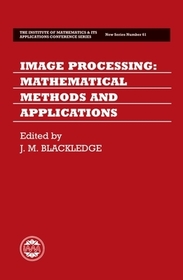
Image Processing
Mathematical Methods and Applications
Series: Institute of Mathematics and its Applications Conference Series (New Series); 61;
- Publisher's listprice GBP 225.00
-
101 587 Ft (96 750 Ft + 5% VAT)
The price is estimated because at the time of ordering we do not know what conversion rates will apply to HUF / product currency when the book arrives. In case HUF is weaker, the price increases slightly, in case HUF is stronger, the price goes lower slightly.
- Discount 10% (cc. 10 158 Ft off)
- Discounted price 91 429 Ft (87 075 Ft + 5% VAT)
Subcribe now and take benefit of a favourable price.
Subscribe
101 587 Ft

Availability
printed on demand
Why don't you give exact delivery time?
Delivery time is estimated on our previous experiences. We give estimations only, because we order from outside Hungary, and the delivery time mainly depends on how quickly the publisher supplies the book. Faster or slower deliveries both happen, but we do our best to supply as quickly as possible.
Product details:
- Publisher OUP Oxford
- Date of Publication 10 April 1997
- ISBN 9780198511977
- Binding Hardback
- No. of pages534 pages
- Size 242x162x34 mm
- Weight 1065 g
- Language English
- Illustrations halftones, line figures, tables 0
Categories
Short description:
The generation, storage and processing of digital images plays a fundamental role in the information technology revolution. Digital image processing technology has developed markedly over the last ten years and more and more information is being conveyed through the display and analysis of digital images. The way in which image data is stored and processed is fundamental to all aspects of IT. Examples include remote sensing using the new generation of digital satellites which carry a range of different sensors that, when coupled with suitable image processing technology, can provide a wealth of information to geologists, geographers and atmospheric physicists used in everything from the exploration of oil and other natural resources to environmental monitoring and agricultural development in the Third World. Other examples include the use of image processing in medical imaging for use in diagnosis using conventional X-ray Computed Tomography to research into the behaviour of the human brain using real-time Magnetic Resonance Imaging. This book consists of twenty-one papers which collectively cover a broad range of image processing problems and the way on which solutions to these problems are used in different area of science and technology. The papers present details of the way in which computers of varying processing power can be programmed to store image efficiently, resolve features and patterns in an image that are either time consuming or impossible for human interpreters and develop machines that can 'see' like humans. The book covers a wide range of applications which include the use of lasers for studying the dynamic behaviour of mechanical components, overviews of image processing in remote sensing and medical imaging and the application of a new form of geometry (fractal geometry) for recognizing patterns which is not possible with conventional data processing. The book will be of value to any engineer, scientist and technologist who wants to acquire information on current research issues in image processing by reading a set of papers prepared by some of the world's leading specialists.
MoreLong description:
The generation, storage and processing of digital images plays a fundamental role in the information technology revolution. Digital imaging processing technology has developed markedly over the last ten years and more and more information is being conveyed through the display and analysis of digital images. The way in which image data is stored and processed is fundamental to all aspects of IT. Examples include remote sensing using the new generation of digital satellites which carry a range of different sensors that, when coupled with suitable image processing technology, can provide a wealth of information to geologists, geographers and atmospheric physicists used in everything from the exploration of oil and other natural resources to environmental monitoring and agricultural development in the Third World. Other examples include the use of image processing in medical imaging for use in diagnosis using conventional X-ray Computed Tomography to research into the behaviour of the human brain using real time Magnetic Resonance Imaging.
This book consists of twenty-one papers which collectively cover a broad range of image processing problems and the way on which solutions to these problems are used in different area of sciences and technology. The papers present details of the way in which computers of varying processing power can be programmed to store image efficiently, resolve features and patterns in an image that are either time consuming or impossible for human interpreters and develop machines that can `see', like humans. The book covers a wide range of applications which include the use of lasers for studying the dynamic behaviour of mechanical components, overviews of image processing in remote sensing and medical imaging and the application of a new form of geometry (fractal geometry) for rcognizing patterns which is not possible with conventional data processing.
The book will be of value to any engineer, scientists and technologist who wants to acquire information on current research issues in image processing by reading a set of papers prepared by some of the world's leading specialists.
...the proceedings provides interesting and necessary reading for both the theoretician and the practitioner of image processing and is recommended to all those actively involved in imaging research.
Table of Contents:
Contents List - Page 1
More
