

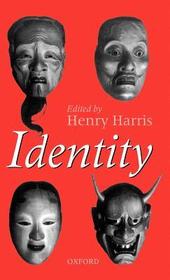
Identity
Essays Based on Herbert Spencer Lectures Given in the University of Oxford
- Publisher's listprice GBP 88.00
-
39 732 Ft (37 840 Ft + 5% VAT)
The price is estimated because at the time of ordering we do not know what conversion rates will apply to HUF / product currency when the book arrives. In case HUF is weaker, the price increases slightly, in case HUF is stronger, the price goes lower slightly.
- Discount 10% (cc. 3 973 Ft off)
- Discounted price 35 759 Ft (34 056 Ft + 5% VAT)
Subcribe now and take benefit of a favourable price.
Subscribe
39 732 Ft

Availability
printed on demand
Why don't you give exact delivery time?
Delivery time is estimated on our previous experiences. We give estimations only, because we order from outside Hungary, and the delivery time mainly depends on how quickly the publisher supplies the book. Faster or slower deliveries both happen, but we do our best to supply as quickly as possible.
Product details:
- Publisher Clarendon Press
- Date of Publication 13 April 1995
- ISBN 9780198235255
- Binding Hardback
- No. of pages182 pages
- Size 228x144x16 mm
- Weight 349 g
- Language English
- Illustrations halftones, line figures, tables 0
Categories
Short description:
Who am I, and what am I? These questions are asked through the ages, and answered in various ways in disciplines ranging from philosphy through literature and politics to biology. It is a matter of personal and practical as well as intellectual interest, and perhaps for this reason academic debate on this subject attracts attention and stimulates controversy outside the ranks of the specialists.
In Identity six internationally famous contributors, Bernard Williams, Derek Parfit, Henry Harris, Michael Ruse, Terence Cave, and Anthony D. Smith, discuss identity from the viewpoints of their various disciplines. The book offers a comparison and cross-fertilization of insights and theories from outside and within philosophy, shedding light on this concept crucial to the humanities and the social and physical sciences.
Long description:
Who am I, and what am I? The question is one asked through the ages, answered in various ways in different disciplines. Identity is a matter of intellectual interest but also of personal and practical interest, attracting attention and stimulating controversy outside the ranks of the specialists. This volume offers a comparison and cross-fertilization of insights and theories from various disciplines in which identity is a key concept.
Identity contains essays by six internationally famous contributors, focusing on different facets of identity from the viewpoint of their various disciplines. Two philosophers, Bernard Williams and Derek Parfit, discuss, respectively, numerical identity (when can we say that two phenomena observed at different times are one and the same thing?) and personal identity (how far can the concept of `I' be stretched, and does it always matter whether we can say if that would still be me?). Henry Harris looks at philosophical discussions of identity from the persopective of an experimentalist, and discusses whether philosophical thought-experiments have any basis in scientific reality.
The essays that follow offer perspectives from outside philosophy: Michael Ruse considers homosexual identity and to what extent it is reasonable to claim that homosexuality is a social construct. Terence Cave looks at personal identity through the eye of literature and fiction, and portrays idetnity as generated through the narratives that one weaves about oneself or about other people. Finally, Anthony D Smith looks at national identities and how they are formed, analysing how this process is shaped by the interplay of cultural inheritance, political expediency, and myth.

