

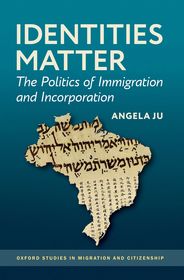
Identities Matter
The Politics of Immigration and Incorporation
Series: Oxford Studies in Migration and Citizenship;
- Publisher's listprice GBP 64.00
-
28 896 Ft (27 520 Ft + 5% VAT)
The price is estimated because at the time of ordering we do not know what conversion rates will apply to HUF / product currency when the book arrives. In case HUF is weaker, the price increases slightly, in case HUF is stronger, the price goes lower slightly.
- Discount 10% (cc. 2 890 Ft off)
- Discounted price 26 006 Ft (24 768 Ft + 5% VAT)
Subcribe now and take benefit of a favourable price.
Subscribe
28 896 Ft

Availability
Estimated delivery time: In stock at the publisher, but not at Prospero's office. Delivery time approx. 3-5 weeks.
Not in stock at Prospero.
Why don't you give exact delivery time?
Delivery time is estimated on our previous experiences. We give estimations only, because we order from outside Hungary, and the delivery time mainly depends on how quickly the publisher supplies the book. Faster or slower deliveries both happen, but we do our best to supply as quickly as possible.
Product details:
- Publisher OUP USA
- Date of Publication 21 May 2025
- ISBN 9780197794982
- Binding Hardback
- No. of pages216 pages
- Size 240x166x23 mm
- Weight 417 g
- Language English 589
Categories
Short description:
Higher-status immigrant communities in the Global South with ties to more developed countries might form identities and political strategies that reinforce an association with their heritage country rather than seek to completely integrate into their host country. Identities Matter: The Politics of Immigration and Incorporation investigates the politically and socially beneficial reasons for this. The case studies illustrating these phenomena are Japanese Brazilians and Jewish Brazilians.
MoreLong description:
Grandchildren of immigrants belonging to groups that have achieved high socioeconomic status choose which identities to leverage in the host country's political arena. The scholarship about political incorporation often assumes that immigrant groups and their descendants find it in their best interest to pursue mainstream political incorporation. Those immigrants who belong to ethnic minority groups might choose to engage politically in a number of ways, depending on their racial or economic status; Identities Matter: The Politics of Immigration and Incorporation looks at how descendants of minoritized groups who have achieved, generally speaking, high socioeconomic status choose to identify politically in their adopted nations. Contrary to many expectations about political and social incorporation of immigrants, it finds that assimilation is not necessarily advantageous for groups who are from or associated with countries that are more economically developed than their host country. When this is the case, these immigrant communities may choose to strategically associate themselves with the heritage country over the one in which they reside.
The book draws on original research among third-generation Japanese and Jewish Brazilians to determine the seemingly paradoxical ways in which the descendants of immigrants choose which identities to emphasize in the political arena. It shows that immigrant communities' strategies of political incorporation and social integration are framed within where they fall in existing ethno-racial and socioeconomic hierarchies, and that perceptions of discrimination drive third-generation descendants to vote in line with their ethnic interests. One particularly interesting finding is that in Brazil, a country that suffers from high levels of political corruption, Japanese Brazilian politicians are often incentivized to emphasize their Japanese-ness over their Brazilian-ness to convey to voters that they are more honest as political candidates than their "more Brazilian" opponents. Finally, ethnic community-based organizations allow these groups to leverage their identities transnationally.
Table of Contents:
List of Figures
List of Tables
Preface
Acknowledgments
Identities of Japanese Brazilians and Jewish Brazilians
Conceptualizing Japanese Brazilian and Jewish Brazilian Identities
The Racial or Color Identity Determinants of Japanese Brazilians and Jewish Brazilians
Leveraging Identities in Brazil
Leveraging Identities with Associated Countries: Ethnic Community-Based Organizations
Conclusion: The Changing Diversity of Brazil
Appendices
Bibliography
Index

