

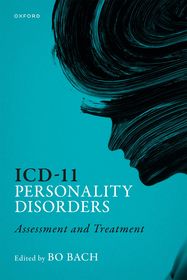
ICD-11 Personality Disorders
Assessment and Treatment
- Publisher's listprice GBP 39.99
-
19 105 Ft (18 195 Ft + 5% VAT)
The price is estimated because at the time of ordering we do not know what conversion rates will apply to HUF / product currency when the book arrives. In case HUF is weaker, the price increases slightly, in case HUF is stronger, the price goes lower slightly.
- Discount 10% (cc. 1 911 Ft off)
- Discounted price 17 194 Ft (16 376 Ft + 5% VAT)
Subcribe now and take benefit of a favourable price.
Subscribe
19 105 Ft

Availability
Estimated delivery time: In stock at the publisher, but not at Prospero's office. Delivery time approx. 3-5 weeks.
Not in stock at Prospero.
Why don't you give exact delivery time?
Delivery time is estimated on our previous experiences. We give estimations only, because we order from outside Hungary, and the delivery time mainly depends on how quickly the publisher supplies the book. Faster or slower deliveries both happen, but we do our best to supply as quickly as possible.
Product details:
- Publisher OUP Oxford
- Date of Publication 20 February 2025
- ISBN 9780192868404
- Binding Paperback
- No. of pages752 pages
- Size 235x158x40 mm
- Weight 1108 g
- Language English 708
Categories
Short description:
ICD-11 Personality Disorders is a comprehensive and clinically helpful overview of ICD-11 personality disorders and related traits, and offers clinical illustrations to guide practitioners.
MoreLong description:
ICD-11 Personality Disorders is a comprehensive and clinically helpful overview of ICD-11 personality disorders and related traits, and offers clinical illustrations to guide practitioners. The volume describes central aspects that are used to determine the presence and severity of personality dysfunction including topics such as identity and agency, malignant self-regard and depressivity, grandiose and vulnerable narcissism, interpersonal dependency, social cognition and perspective-taking, emotion regulation and affect integration, dissociative and psychotic features, psychopathy and interpersonal harm, and self-harm.
The volume provides differential diagnostic guidelines in relation to other persistent mental disorders such as autism spectrum, ADHD, schizotypal disorder, bipolar disorders, and Complex PTSD. The wide array of contributors integrate a range of evidence-based psychotherapy approaches including Dialectical Behaviour Therapy (DBT), Mentalization Based Therapy (MBT), Transference-Focused Therapy (TFP), Cognitive Behaviour Therapy (CBT), Intensive Short-Term Dynamic Psychotherapy (ISTDP), Metacognitive Interpersonal Therapy (MIT), Good Psychiatric Management (GPM), Nidotherapy, and Schema Therapy to describe the available instruments and measures, including how to use different sources of diagnostic information.
Table of Contents:
Part 1. Assessment and Classification
General Diagnostic Requirements and Differential Diagnosis
Determining Personality Disorder Severity
Trait Domain Specifiers
Borderline Pattern Specifier
Crosswalk for ICD-10 and DSM-5 Personality Disorder Types
Instruments and Other Sources of Diagnostic Information
Part 2. Aspects and Manifestations of Personality Disturbances
Maladaptive Sense of Identity and Agency
Malignant Self-Regard and Characterological Depressivity
Interpersonal Dependency
Grandiose and Vulnerable Narcissism
Maladaptive Social Cognition and Perspective-Taking
Emotional Dysfunction: Difficulties in Emotion Regulation and Affect Integration
Dissociative and Psychotic Features
Psychopathy and Interpersonal Harm
Self-Harm Behavior
Part 3. Evidence-Based Treatment
Transference-Focused Psychotherapy
Dialectical Behavior Therapy
Radically Open Dialectical Behavior Therapy
Mentalization-Based Treatment
Schema Therapy
Metacognitive Interpersonal Therapy
Good Psychiatric Management
Compass: Cognitive Behavioral Modules for Personality Symptoms
Intensive Short-Term Dynamic Psychotherapy
Nidotherapy
Part 4. Specific Clinical Application
Treatment Planning and Evaluation
Psychoeducation and Case-formulation
Utility in Forensic Practice
Clinical Management of Co-Occurring Addictions
Application to Children and Young People
Application to Older People
Neuroscientific Considerations
Cross-Cultural Application
Health Policies Informed by Severity Classification: A UK Perspective
A Lived Experience and Recovery Perspective

