

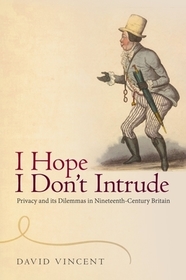
I Hope I Don't Intrude
Privacy and its Dilemmas in Nineteenth-Century Britain
- Publisher's listprice GBP 28.49
-
13 611 Ft (12 962 Ft + 5% VAT)
The price is estimated because at the time of ordering we do not know what conversion rates will apply to HUF / product currency when the book arrives. In case HUF is weaker, the price increases slightly, in case HUF is stronger, the price goes lower slightly.
- Discount 10% (cc. 1 361 Ft off)
- Discounted price 12 249 Ft (11 666 Ft + 5% VAT)
Subcribe now and take benefit of a favourable price.
Subscribe
13 611 Ft

Availability
Uncertain availability. Please turn to our customer service.
Why don't you give exact delivery time?
Delivery time is estimated on our previous experiences. We give estimations only, because we order from outside Hungary, and the delivery time mainly depends on how quickly the publisher supplies the book. Faster or slower deliveries both happen, but we do our best to supply as quickly as possible.
Product details:
- Publisher OUP Oxford
- Date of Publication 14 May 2015
- ISBN 9780198725039
- Binding Hardback
- No. of pages368 pages
- Size 240x179x25 mm
- Weight 672 g
- Language English
- Illustrations 36 black and white figures/illustrations 0
Categories
Short description:
Taking his title from the catch-phrase of the eponymous hero of the 1825 play Paul Pry, a huge success in London, New York, and around the English-speaking world, David Vincent explores the worlds of privacy and celebrity in nineteenth-century Britain, examining debates about mass communication and state surveillance that link to today's concerns.
MoreLong description:
'I Hope I Don't Intrude' takes its title from the catch-phrase of the eponymous hero of the 1825 play Paul Pry, which was an immense success on the London stage and then rapidly in New York and around the English-speaking world. It tackles the complex, multi-faceted subject of privacy in nineteenth-century Britain by examining the way in which the tropes, language, and imagery of the play entered public discourse about privacy in the rest of the century. The volume is not just an account of a play, or of late Georgian and Victorian theatre. Rather it is a history of privacy, showing how the play resonated through Victorian society and revealed its concerns over personal and state secrecy, celebrity, gossip and scandal, postal espionage, virtual privacy, the idea of intimacy, and the evolution of public and private spheres.
After 1825 the overly inquisitive figure of Paul Pry appeared everywhere - in songs, stories, and newspapers, and on everything from buttons and Staffordshire pottery to pubs, ships, and stagecoaches - and 'Paul-Prying' rapidly entered the language. 'I Hope I Don't Intrude' is an innovative kind of social history, using rich archival research to trace this cultural artefact through every aspect of its consumer context, and using its meanings to interrogate the largely hidden history of privacy in a period of major transformations in the role of the home, mass communication (particularly the new letter post, which delivered private messages through a public service), and the state. In vivid and entertaining detail, including many illustrations, David Vincent presents the most thorough account yet attempted of a recreational event in an era which saw a decisive shift in consumer markets. His study casts fresh light on the perennial tensions between curiosity and intrusion that were captured in Paul Pry and his catchphrase. Giving a new account of the communications revolution of the period, it re-evaluates the role of the state and the market in creating a new regime of privacy. And its critique of the concept and practice of surveillance looks forward to twenty-first-century concerns about the invasion of privacy through new technologies.
In its analysis of popular theatre, print culture, and satire this is an impressive volume.
Table of Contents:
Acknowledgments
List of Illustrations
Part One: Introduction
Enter Pry
The General Truth of the Delineation
Part Two: The Performance of Paul Pry
The Moderate C.
The Paul Pry Industry
The Dynamics of the Market
Part Three: The Dilemmas of Privacy
The Spirit of Inquiry
Intrusion
Virtual Privacy
Part Four: Conclusion
Comedy and Error
Bibliography

