

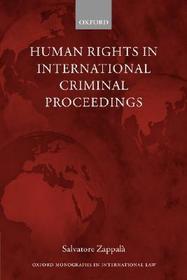
Human Rights in International Criminal Proceedings
Series: Oxford Monographs in International Law;
- Publisher's listprice GBP 49.99
-
23 882 Ft (22 745 Ft + 5% VAT)
The price is estimated because at the time of ordering we do not know what conversion rates will apply to HUF / product currency when the book arrives. In case HUF is weaker, the price increases slightly, in case HUF is stronger, the price goes lower slightly.
- Discount 10% (cc. 2 388 Ft off)
- Discounted price 21 494 Ft (20 471 Ft + 5% VAT)
Subcribe now and take benefit of a favourable price.
Subscribe
23 882 Ft

Availability
printed on demand
Why don't you give exact delivery time?
Delivery time is estimated on our previous experiences. We give estimations only, because we order from outside Hungary, and the delivery time mainly depends on how quickly the publisher supplies the book. Faster or slower deliveries both happen, but we do our best to supply as quickly as possible.
Product details:
- Publisher OUP Oxford
- Date of Publication 27 January 2005
- ISBN 9780199280933
- Binding Paperback
- No. of pages312 pages
- Size 234x156x18 mm
- Weight 483 g
- Language English 0
Categories
Short description:
This book deals with the protection of human rights in international criminal proceedings. Its basic assumption is that human rights are the yardstick against which to measure the conformity of international criminal proceedings with the rule of law and fundamental principles of justice.
Zappalà concludes that although human rights are today at the core of international criminal proceedings, there still are some areas in which improvements are desirable.
Long description:
This book takes a procedural approach to human rights guarantees in international criminal proceedings and covers both the systems of the ad hoc Tribunals for the former Yugoslavia and Rwanda and the International Criminal Court. It analyses the rights conferred on individuals involved in international criminal trials from the commencement of investigations to the sentencing stage, as well as the procedural rights of victims and witnesses.
The study focuses on problems which have emerged in three main areas: (i) length of proceedings; (ii) absence of specific sanctions and other remedies for violation of procedural rules; (iii) the need to strengthen the protection of the accused from undue interference with his rights (likely to be caused by a variety of factors, such as conflicting governmental interests, the presence of malicious witnesses, or inadequate legal assistance). Three general suggestions are made to reduce the impact of these weaknesses. First, it could be helpful to adopt specific sanctions for violation of procedural rules (such as, the exclusion of evidence as a remedy for violations of rules on discovery). Secondly, (as has already been provided for in the ICC Statute,) the Prosecutor of the ad hoc Tribunals should play a proactive role in the search for the truth by, among other things, gathering evidence that might exonerate the accused. Thirdly, the right of compensation for unlawful arrest (or detention) and unjust conviction, provided for in the ICC Statute, should be extended to other serious violations of fundamental rights and, in addition, should be laid down in the Statutes of the ICTY and ICTR.
This study is an ambitious one, which is detailed in its research and covers a broad range of often complex issues well...A valuable addition to scholarship in this area...This well researched historical piece makes an interesting argument and contributes to Nuremberg scholarship from the legal perspective because of its detailed and constructive criticism of the results.
Table of Contents:
Chapter 1 INTRODUCTION
A HUMAN RIGHTS APPROACH TO INTERNATIONAL CRIMINAL JUSTICE
THE EXTENSION OF THE NOTION OF FAIR TRIAL TO INTERNATIONAL CRIMINAL PROCEEDINGS
WHAT TYPE OF RELATIONSHIP EXISTS BETWEEN HUMAN RIGHTS MONITORING SYSTEMS AND INTERNATIONAL CRIMINAL COURTS?
ACCUSATORIAL AND INQUISITORIAL MODELS IN INTERNATIONAL CRIMINAL PROCEDURE - TO WHAT EXTENT DO THEY IMPINGE UPON THE RIGHTS OF INDIVIDUALS?
Chapter 2 THE RIGHTS OF PERSONS DURING INVESTIGATIONS
THE INITIATION OF INVESTIGATIONS AND THE POWERS OF THE INVESTIGATIVE AUTHORITY
THE RIGHTS OF SUSPECTS IN INTERNATIONAL CRIMINAL PROCEEDINGS
Chapter 3 THE RIGHTS OF THE ACCUSED IN TRIAL PROCEEDINGS
THE PRESUMPTION OF INNOCENCE
THE RIGHT TO BE JUDGED BY AN INDEPENDENT AND IMPARTIAL TRIBUNAL
THE RIGHT TO A FAIR AND EXPEDITIOUS TRIAL
RULES OF EVIDENCE AND RIGHTS OF THE ACCUSED - SOME PROBLEMATICAL ISSUES
Chapter 4 THE RIGHT OF THE ACCUSED TO APPEAL AND REVISION
GENERAL - THE RIGHTS OF APPEAL AND REVISION AS A MEANS FOR OBTAINING REDRESS (JUDICIAL AND NON-JUDICIAL REMEDIES
THE RIGHT OF THE ACCUSED TO APPEAL: FROM NUREMBERG AND TOKYO TO THE AD HOC TRIBUNALS AND THE ICC
THE RIGHT OF CONVICTED PERSONS TO REVIEW
CONCLUDING REMARKS
Chapter 5 PENALTIES, ENFORCEMENT MECHANISMS AND THE RIGHTS OF CONVICTED PERSONS
THE MAJOR GOALS OF INTERNATIONAL PENALTIES AND THE LEGAL EXPECTATIONS OF CONVICTED PERSONS
THE ENFORCEMENT MECHANISMS AND THE RIGHTS OF SENTENCED PERSONS
Chapter 6 THE POSITION OF PERSONS OTHER THAN THE ACCUSED
VICTIMS
WITNESSES
Chapter 7 CONCLUDING REMARKS
THE CENTRAL ROLE OF HUMAN RIGHTS IN INTERNATIONAL TRIALS: FROM NUREMBERG TO ROME
THE PROBLEM OF PROCEDURAL MODELS: THE NEED FOR A PRINCIPLED APPROACH TO INTERNATIONAL CRIMINAL PROCEDURE
RESPECT FOR HUMAN RIGHTS IN INTERNATIONAL TRIALS: A FEW OUTSTANDING PROBLEMS
GENERAL SUGGESTIONS FOR IMPROVING HUMAN RIGHTS PROTECTION IN INTERNATIONAL CRIMINAL PROCEEDINGS

