

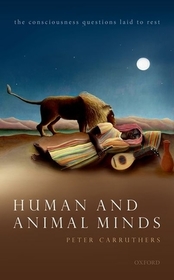
Human and Animal Minds
The Consciousness Questions Laid to Rest
- Publisher's listprice GBP 27.49
-
13 133 Ft (12 507 Ft + 5% VAT)
The price is estimated because at the time of ordering we do not know what conversion rates will apply to HUF / product currency when the book arrives. In case HUF is weaker, the price increases slightly, in case HUF is stronger, the price goes lower slightly.
- Discount 10% (cc. 1 313 Ft off)
- Discounted price 11 819 Ft (11 256 Ft + 5% VAT)
Subcribe now and take benefit of a favourable price.
Subscribe
13 133 Ft

Availability
printed on demand
Why don't you give exact delivery time?
Delivery time is estimated on our previous experiences. We give estimations only, because we order from outside Hungary, and the delivery time mainly depends on how quickly the publisher supplies the book. Faster or slower deliveries both happen, but we do our best to supply as quickly as possible.
Product details:
- Publisher OUP Oxford
- Date of Publication 5 December 2019
- ISBN 9780198843702
- Binding Hardback
- No. of pages234 pages
- Size 224x144x18 mm
- Weight 406 g
- Language English 0
Categories
Short description:
Claims about consciousness in animals are often made in support of their moral standing. Peter Carruthers argues that there is no fact of the matter about animal consciousness and it is of no scientific or ethical significance. Sympathy for an animal can be grounded in its mental states, but should not rely on assumptions about its consciousness.
MoreLong description:
The continuities between human and animal minds are increasingly well understood. This has led many people to make claims about consciousness in animals, which has often been taken to be crucial for their moral standing. Peter Carruthers argues compellingly that there is no fact of the matter to be discovered, and that the question of animal consciousness is of no scientific or ethical significance.
Carruthers offers solutions to two related puzzles. The first is about the place of phenomenal--or felt--consciousness in the natural order. Consciousness is shown to comprise fine-grained nonconceptual contents that are "globally broadcast" to a wide range of cognitive systems for reasoning, decision-making, and verbal report. Moreover, the so-called "hard" problem of consciousness results merely from the distinctive first-person concepts we can use when thinking about such contents. No special non-physical properties--no so-called "qualia"--are involved. The second puzzle concerns the distribution of phenomenal consciousness across the animal kingdom. Carruthers shows that there is actually no fact of the matter, because thoughts about consciousness in other creatures require us to project our first-person concepts into their minds; but such projections fail to result in determinate truth-conditions when those minds are significantly unlike our own. This upshot, however, doesn't matter. It doesn't matter for science, because no additional property enters the world as one transitions from creatures that are definitely incapable of phenomenal consciousness to those that definitely are (namely, ourselves). And on many views it doesn't matter for ethics, either, since concern for animals can be grounded in sympathy, which requires only third-person understanding of the desires and emotions of the animals in question, rather than in first-person empathy.
Ironically, we are presented with a book whose well-structured chapters offer a series of complex conceptual analyses and empirically-informed arguments about different aspects of consciousness in humans and animals just to recommend readers that 'they should stop thinking about consciousness and start investing their time in more important things.' It is a worthy and enlightening reading, though.
Table of Contents:
Important preliminaries
Animal minds: The state of the art
The need for a theory
Some initial possibilities
Global-workspace theory
Explaining the "hard" problem
Animal consciousness: No fact of the matter
Does consciousness matter?

