

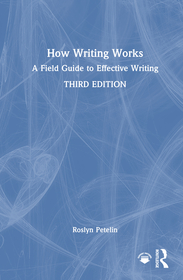
How Writing Works
A Field Guide to Effective Writing
-
GET 10% OFF
- Publisher's listprice GBP 155.00
-
69 982 Ft (66 650 Ft + 5% VAT)
The price is estimated because at the time of ordering we do not know what conversion rates will apply to HUF / product currency when the book arrives. In case HUF is weaker, the price increases slightly, in case HUF is stronger, the price goes lower slightly.
- Discount 10% (cc. 6 998 Ft off)
- Discounted price 62 984 Ft (59 985 Ft + 5% VAT)
62 984 Ft

Availability
Not yet published.
Why don't you give exact delivery time?
Delivery time is estimated on our previous experiences. We give estimations only, because we order from outside Hungary, and the delivery time mainly depends on how quickly the publisher supplies the book. Faster or slower deliveries both happen, but we do our best to supply as quickly as possible.
Product details:
- Edition number 3
- Publisher Routledge
- Date of Publication 16 June 2026
- ISBN 9781041158080
- Binding Hardback
- No. of pages332 pages
- Size 234x156 mm
- Language English
- Illustrations 32 Illustrations, black & white; 32 Line drawings, black & white 700
Categories
Short description:
This is an engaging and practical introduction to the elements of grammar, sentence structure, and style that you need to write well across a range of academic, creative, and professional contexts, deftly combining practical strategies with scholarly principles.
MoreLong description:
This is an engaging and practical introduction to the elements of grammar, sentence structure, and style that you need to write well across a range of academic, creative, and professional contexts, deftly combining practical strategies with scholarly principles. It provides a broad-ranging, substantial, and compelling introduction to the elements of writing in contemporary academic, creative, and professional workplaces.
This book includes advice on reading, word choice, grammar, sentence structure and style, paragraphing, structuring and designing text, punctuation, academic and workplace documents, content for social media, revising, editing, and proofreading. Advice, which, if followed, will result in rhetorically sophisticated, stylistically and structurally accomplished writers. Featuring explicit and systematic strategies grounded in scholarly principles, this book takes into account the recent potential contribution of artificial intelligence (GenAI) to the writing arena. The book contains a wide range of resources, with rich cultural and literary print and online references. It also features practical activities supplemented by support materials online.
This is an engaging and practical introduction to the elements of grammar, sentence structure, and style that you need to write well across a range of academic, creative, and professional contexts, deftly combining reliable strategies with scholarly principles.
The third edition includes updated material based on a longstanding commitment to writing and to best international practice. It takes into account the huge upsurge in interest and adoption of generative AI in the writing workplace and the writing classroom. Chapters include advice on reading; language; grammar and style; structuring; designing; paragraphing; punctuation; workplace and academic documents; digital writing for social media; and revising, editing, and proofreading.
How Writing Works should be on the desk of everyone who needs to write: students, professionals in all fields, and creative writers. It is an essential handbook for working writers and writing workers in the contemporary writing-reliant workplace.
The accompanying companion website includes video interviews and presentations from leading grammarians including Professor David Crystal, Professor Mignon Fogarty (Grammar Girl), and Professor Geoff Pullum, in addition to online quizzes and activities to support readers’ learning.
The Learning Support Materials that accompany How Writing Works are a marvellously valuable, and immensely enjoyable, source of information and inspiration for both teachers of writing and writers, whether at university or elsewhere.
Professor Rosemary Williamson, Head, School of Humanities, Arts and Social Sciences, University of New England
PRAISE FOR PREVIOUS EDITIONS
‘What Roslyn Petelin doesn't know about clear, precise writing isn't worth knowing’.
Leigh Sales, Australian Broadcasting Corporation TV
‘How Writing Works is the opposite of a dry writing bible. Those who take the time to read and follow the strategies will be rewarded with the ultimate writing resource’.
Writing Queensland
‘A superb guide to great writing in the modern media era’.
Phil Harding, journalist and broadcaster, London
‘Whether you’re a CEO or an intern, the ability to communicate clearly is your biggest asset. Petelin’s expert advice in this book will accelerate your career’.
Damian Kington, Investor, Brand Consultant, and Strategy Adviser, New York
‘How Writing Works will be an enormous support for undergraduates and postgraduates who want to be the best writers possible. It will also help to prepare them for success in the communication industries, whether as author, editor, publicist, or publisher’.
Jeri Kroll, Professor of English and Creative Writing, Flinders University, Australia
‘How Writing Works will be invaluable for all students from undergraduate to doctoral level, especially as a guide to the construction of robust and coherent argument’.
Margo Blythman, Former Director of Teaching and Learning, University of the Arts, London
‘It's time for a new President for the Republic of Writing: Petelin's book will win her subjects from students to experienced professionals electing to learn why writing is so vital and to follow her lively learning pathways on how to do it elegantly, vividly, and with precision’.
Professor David McKie, University of Waikato, New Zealand
‘Roslyn Petelin is the best of the best in teaching clear, readable writing. This book will improve the writing of everyone who reads it’.
Lelia Green, PhD Professor of Communications, School of Arts and Humanities, Edith Cowan University, Perth
‘The rich research and illuminating examples in this witty and engaging book, along with the further readings and references alone are worth the cost of admission!’
Jodi Simpson, Senior Editor, Laurence King Publishing, London
MoreTable of Contents:
1. How writing works 2. How reading works 3. How words work 4. How sentences and content words work 5. How structure words and paragraphs work 6. How punctuation works 7. How structure and design work 8. How genres and workplace documents work 9. How academic research and writing work 10. How digital writing works 11. How revising, editing, and proofreading work
More
