

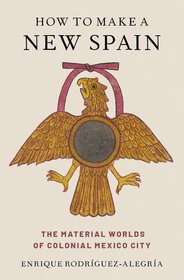
How to Make a New Spain
The Material Worlds of Colonial Mexico City
- Publisher's listprice GBP 94.00
-
44 908 Ft (42 770 Ft + 5% VAT)
The price is estimated because at the time of ordering we do not know what conversion rates will apply to HUF / product currency when the book arrives. In case HUF is weaker, the price increases slightly, in case HUF is stronger, the price goes lower slightly.
- Discount 10% (cc. 4 491 Ft off)
- Discounted price 40 418 Ft (38 493 Ft + 5% VAT)
Subcribe now and take benefit of a favourable price.
Subscribe
44 908 Ft

Availability
Estimated delivery time: In stock at the publisher, but not at Prospero's office. Delivery time approx. 3-5 weeks.
Not in stock at Prospero.
Why don't you give exact delivery time?
Delivery time is estimated on our previous experiences. We give estimations only, because we order from outside Hungary, and the delivery time mainly depends on how quickly the publisher supplies the book. Faster or slower deliveries both happen, but we do our best to supply as quickly as possible.
Product details:
- Publisher OUP USA
- Date of Publication 4 May 2023
- ISBN 9780197682296
- Binding Hardback
- No. of pages344 pages
- Size 162x242x23 mm
- Weight 798 g
- Language English 459
Categories
Short description:
How to Make a New Spain presents an unprecedented view of the material worlds of Mexico City in the sixteenth century, drawing from a combination of sources and methodologies. It presents the author's original analysis of over 11,000 items in the probate inventories of thirty-nine Spanish colonizers. It also synthesizes information from archaeological excavations of Spanish houses at the center of Mexico City.
MoreLong description:
How to Make a New Spain presents an unprecedented view of the material worlds of Mexico City in the sixteenth century, drawing from a combination of sources and methodologies. It presents the author's original analysis of over 11,000 items in the probate inventories of thirty-nine Spanish colonizers. It also synthesizes information from archaeological excavations of Spanish houses at the center of Mexico City.
The book begins with a critique of theories of materiality, in which scholars emphasize the agency of things at the expense of an investigation of social relationships. Rodríguez-Alegría argues that now that scholars have shown that the descendants of the Mexica (often known as the Aztecs) maintained social and political power in the colonial period, we should reexamine how Indigenous people, colonizers, and Black people together created the material and social worlds of colonial Mexico. The book assimilates information on architecture, money, clothing, furniture, pottery, slaves, livestock, and tools to provide a new vision of daily life in colonial Mexico City. It shows that colonialism was based on the recognition of people of similar classes across ethnic boundaries, and on the forging of relationships with powerful Indigenous people. Even colonizers who sought to display distinction from Indigenous people with their material culture depended on Indigenous products and technology to achieve that distinction. The complex history of materiality and power that emerges from this book compels us to reimagine colonial Mexico and the people who created it.
This book serves as an exemplary work of ethnohistory, employing both archaeological findings and records of deceased early colonizers' possessions to compose a comprehensive view of the material life of the Spanish inhabitants of New Spain.... [It] should be read by all scholars and graduate students interested in materiality, urban Latin America, or colonial New Spain.
Table of Contents:
Preface
Acknowledgments
A Note on Terminology and Gentilics
How to enter the material and social worlds
Chapter 1: How to make money
Chapter 2: How to build houses
Chapter 3: How to furnish a house
Chapter 4: How to get pottery and food
Chapter 5: How to dress the part
Chapter 6: How to build sociotechnical systems: tools, livestock, and slaves
Chapter 7: How to link wealth and consumption, or not
Conclusion: The Material Worlds of Spanish Colonizers
Appendix 5.1: Items of clothing in the probate inventories
Appendix 6.1: Tools listed in the documents
Appendix 7.1: Prices of shirts with an indicated origin
References

