

- Publisher's listprice GBP 90.00
-
40 635 Ft (38 700 Ft + 5% VAT)
The price is estimated because at the time of ordering we do not know what conversion rates will apply to HUF / product currency when the book arrives. In case HUF is weaker, the price increases slightly, in case HUF is stronger, the price goes lower slightly.
- Discount 20% (cc. 8 127 Ft off)
- Discounted price 32 508 Ft (30 960 Ft + 5% VAT)
- Discount is valid until: 30 June 2026
Subcribe now and take benefit of a favourable price.
Subscribe
40 635 Ft

Availability
Not yet published.
Why don't you give exact delivery time?
Delivery time is estimated on our previous experiences. We give estimations only, because we order from outside Hungary, and the delivery time mainly depends on how quickly the publisher supplies the book. Faster or slower deliveries both happen, but we do our best to supply as quickly as possible.
Product details:
- Publisher Edward Elgar Publishing
- Date of Publication 5 March 2026
- ISBN 9781035327065
- Binding Hardback
- No. of pages186 pages
- Size 234x156 mm
- Weight 422 g
- Language English 684
Categories
Short description:
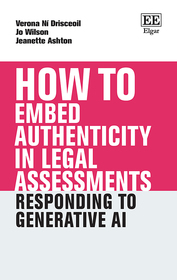
Against the backdrop of the challenges and opportunities presented by the advances in generative AI, this book combines a critical, yet practical, examination of the place of authenticity in legal assessment in higher education.
MoreLong description:
Against the backdrop of the challenges and opportunities presented by the advances in generative AI, this book combines a critical, yet practical, examination of the place of authenticity in legal assessment in higher education.
Part I and Part II evaluates the ever-evolving concept of authenticity in, and for, assessment, examines the role of authenticity within the employability agenda and considers how law schools might respond to the advances in generative AI. Throughout, the authors deliberate current issues for legal education including assessment validity and the impact of AI and generative AI on student learning and cognitive function. Part III, drawing on 20 diverse legal assessment case studies from legal educators across the UK, presents examples of innovative and creative legal assessments and how these have been, or may be, adopted to respond to the advances in generative AI.
How to Embed Authenticity in Legal Assessments is an essential read for legal educators and researchers interested in legal assessment and the future of legal education. It will also be beneficial for senior leadership teams seeking to integrate valid, fair, and innovative assessment design into their law curriculums.
‘At a time when AI is evolving, many of the challenges law teachers face when deciding how to use assessment effectively can only be met by creative strategies. This thought-provoking book provides the educational context with plenty of original examples augmented by excellent case studies. A must-read!’ More
Table of Contents:
Contents
Preface xiii
PART I UNPACKING ‘AUTHENTICITY’ IN, AND FOR,
ASSESSMENT
1 Introduction: authenticity as the antithesis to artificial 2
Verona Ní Drisceoil, Jo Wilson and Jeanette Ashton
2 What is authenticity in legal assessment? From a binary
construct, to a multi-dimensional spectrum, to a tool of
empowerment? 14
Jo Wilson
3 Empowerment and widening opportunities through legal
assessment: navigating the employability agenda 28
Jeanette Ashton
PART II GENERATIVE AI, LEGAL EDUCATION AND ASSESSMENT
4 Generative AI, legal education and legal practice: the need for
a thoughtful reckoning 45
Verona Ní Drisceoil
5 Responding to the advances in generative AI at programme
level: multiple interpretations of authenticity in legal
assessment required 61
Verona Ní Drisceoil
PART III CASE STUDIES
6 From podcasts to posters: twenty case study examples of
authenticity in legal assessment 72
Jeanette Ashton and Jo Wilson
7 Conclusion: authenticity in legal assessment can create and
widen opportunities 165
Verona Ní Drisceoil

