

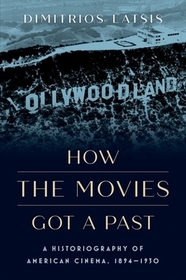
How the Movies Got a Past
A Historiography of American Cinema, 1894-1930
- Publisher's listprice GBP 79.00
-
35 668 Ft (33 970 Ft + 5% VAT)
The price is estimated because at the time of ordering we do not know what conversion rates will apply to HUF / product currency when the book arrives. In case HUF is weaker, the price increases slightly, in case HUF is stronger, the price goes lower slightly.
- Discount 10% (cc. 3 566 Ft off)
- Discounted price 32 102 Ft (30 573 Ft + 5% VAT)
Subcribe now and take benefit of a favourable price.
Subscribe
35 668 Ft

Availability
Estimated delivery time: In stock at the publisher, but not at Prospero's office. Delivery time approx. 3-5 weeks.
Not in stock at Prospero.
Why don't you give exact delivery time?
Delivery time is estimated on our previous experiences. We give estimations only, because we order from outside Hungary, and the delivery time mainly depends on how quickly the publisher supplies the book. Faster or slower deliveries both happen, but we do our best to supply as quickly as possible.
Product details:
- Publisher OUP USA
- Date of Publication 22 September 2023
- ISBN 9780197689271
- Binding Hardback
- No. of pages408 pages
- Size 242x163x26 mm
- Weight 708 g
- Language English
- Illustrations 50 b/w images 422
Categories
Short description:
How the Movies Got a Past presents a comprehensive survey of the rise of historiographical discourse on cinema in North America as it is reflected in publications, exhibitions, lectures, and films about the cinema as a technology, artform, and source of entertainment, from its inception up to 1930. With a wealth of case studies and illustrations, this book will appeal to media historians, silent movie buffs, film archivists, and students alike.
MoreLong description:
How the Movies Got a Past presents a comprehensive survey of the rise of historiographical discourse on cinema in North America as it is reflected in publications, exhibitions, lectures, and films about the cinema as a technology, form of art, and source of entertainment, from its inception up to 1930. This pioneering historiography of American movies proposes a typology of genres of historical knowledge and examines the role that its articulation played in legitimating the moving image as a form of cultural heritage and a field of study.
How did early studios seek to understand and promote their own activities as part of a brand-new form of entertainment with its own traditions, "founding fathers," and ambitions? How did early writers modulate between retrospection and analysis, between nostalgia and ballyhoo, between journalism and research into the "relics" of the nascent film industry and what were their motivations and influence on subsequent historians? What rhetorical and material platforms were deployed to talk about and show the history of cinema and for what audiences were they meant? In teasing out answers to these and other questions, this book makes an argument for early cinema historiography as an emergent genre with its own conventions and goals instead of a "primitive" version of today's historical writing on the movies. With a wealth of case studies, and illustrations, How the Movies Got a Past will appeal to media historians, silent movie buffs, film archivists, and students alike.
This important book transforms our understanding of the history of early cinema by expanding on the limited range of material that past studies have drawn upon. Supported by extensive research, Latsis creates a lucid study supported by a wide range of sources, including industry self studies.
Table of Contents:
Acknowledgments
Introduction: The Evolving Practice of Film Historiography
Part I: Historiography
1. A Vivisection: Writing the History of an Emergent Medium
2. The First Canonical Histories: Ramsaye, Rotha and Beyond
3. Finding Its Voice? Sound and the (Re)-writing of Film History
PART II: Meta-History
4. Through a Glass Darkly: Early Nonfiction Films about the History of Cinema
5. Programming the Classics: Revivals, The Little Theater Movement and the Emergence of a Canon
6. The Future-Past of Moving Images: Towards a Pre-history of Film Archiving
7. Exhibitions and Museums: The Past of Cinema on Display
8. Invented Traditions: Commemorations and Anniversaries
9. Learning and Earning: Film History Enters the University Curriculum
Conclusion
Appendix: Silent Non-Fiction Films Related to the History of Cinema
Bibliography
Index

