

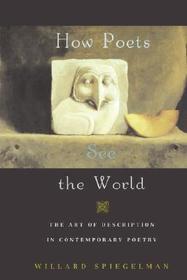
How Poets See the World
The Art of Description in Contemporary Poetry
- Publisher's listprice GBP 34.99
-
15 797 Ft (15 045 Ft + 5% VAT)
The price is estimated because at the time of ordering we do not know what conversion rates will apply to HUF / product currency when the book arrives. In case HUF is weaker, the price increases slightly, in case HUF is stronger, the price goes lower slightly.
- Discount 10% (cc. 1 579 Ft off)
- Discounted price 14 218 Ft (13 541 Ft + 5% VAT)
Subcribe now and take benefit of a favourable price.
Subscribe
15 797 Ft

Availability
printed on demand
Why don't you give exact delivery time?
Delivery time is estimated on our previous experiences. We give estimations only, because we order from outside Hungary, and the delivery time mainly depends on how quickly the publisher supplies the book. Faster or slower deliveries both happen, but we do our best to supply as quickly as possible.
Product details:
- Publisher OUP USA
- Date of Publication 21 June 2007
- ISBN 9780195332926
- Binding Paperback
- No. of pages256 pages
- Size 234x156x13 mm
- Weight 363 g
- Language English 0
Categories
Short description:
Although readers of prose fiction sometimes find descriptive passages superfluous or boring, description itself is often the most important aspect of a poem. This book examines how a variety of contemporary poets use description in their work. Description has been the great burden of poetry. How do poets see the world? How do they look at it? What do they look for? Is description an end in itself, or a means of expressing desire? Ezra Pound demanded that a poem should represent the external world as objectively and directly as possible, and William Butler Yeats, in his introduction to The Oxford Book of Modern Verse (1936), said that he and his generation were rebelling against, inter alia, "irrelevant descriptions of nature" in the work of their predecessors. The poets in this book, however, who are distinct in many ways from one another, all observe the external world of nature or the reflected world of art, and make relevant poems out of their observations.
MoreLong description:
Although readers of prose fiction sometimes find descriptive passages superfluous or boring, description itself is often the most important aspect of a poem. This book examines how a variety of contemporary poets use description in their work. Description has been the great burden of poetry. How do poets see the world? How do they look at it? What do they look for? Is description an end in itself, or a means of expressing desire? Ezra Pound demanded that a poem should represent the external world as objectively and directly as possible, and William Butler Yeats, in his introduction to The Oxford Book of Modern Verse (1936), said that he and his generation were rebelling against, inter alia, "irrelevant descriptions of nature" in the work of their predecessors. The poets in this book, however, who are distinct in many ways from one another, all observe the external world of nature or the reflected world of art, and make relevant poems out of their observations.
Spiegelman's masterly study of the persistence of the descriptive impulse in contemporary poetry, ranging from Tomlinson's just looking (the play on words is Tomlinson's) to Graham's ongoing search for a new way of looking, demonstrated how resourceful poets of various stripes engage themselves and the reader in inventive acts of looking at the visible world. Spiegelman has served his poets, and the art of poetry, well.

