

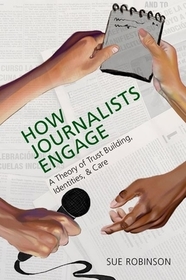
How Journalists Engage
A Theory of Trust Building, Identities, and Care
- Publisher's listprice GBP 20.99
-
9 476 Ft (9 025 Ft + 5% VAT)
The price is estimated because at the time of ordering we do not know what conversion rates will apply to HUF / product currency when the book arrives. In case HUF is weaker, the price increases slightly, in case HUF is stronger, the price goes lower slightly.
- Discount 10% (cc. 948 Ft off)
- Discounted price 8 529 Ft (8 123 Ft + 5% VAT)
Subcribe now and take benefit of a favourable price.
Subscribe
9 476 Ft

Availability
Estimated delivery time: In stock at the publisher, but not at Prospero's office. Delivery time approx. 3-5 weeks.
Not in stock at Prospero.
Why don't you give exact delivery time?
Delivery time is estimated on our previous experiences. We give estimations only, because we order from outside Hungary, and the delivery time mainly depends on how quickly the publisher supplies the book. Faster or slower deliveries both happen, but we do our best to supply as quickly as possible.
Product details:
- Publisher OUP USA
- Date of Publication 27 July 2023
- ISBN 9780197667125
- Binding Paperback
- No. of pages264 pages
- Size 159x235x15 mm
- Weight 381 g
- Language English 415
Categories
Short description:
In this book, Sue Robinson explores how journalists of different identities, especially racial, enact trusting relationships with their audiences. Drawing from case studies, community-work, interviews, and focus groups, she documents an emergent ecosystem around trust building and engagement journalism that represents the first major paradigm shift of the press's core values in more than a century. Developing a new theory of trust building, Robinson calls for journalists to grapple actively with their own identities--especially the privileges, biases, and marginalization attached to them--and those of their communities, resulting in a more intentional and effective moral voice focused on justice and equity through the news practice of an ethic of care.
MoreLong description:
A unique theory of trust building in engagement journalism that proposes journalists move to an ethic of care as they prioritize listening and learning within communities instead of propping up problematic institutions.
In How Journalists Engage, Sue Robinson explores how journalists of different identities, especially racial, enact trusting relationships with their audiences. Drawing from case studies, community-work, interviews, and focus groups, she documents a growing built environment around trust building and engagement journalism that represents the first major paradigm shift of the press's core values in more than a century. As Robinson shows, journalists are being trained to take on new roles and skillsets around listening and learning, in addition to normative routines related to being a watchdog and storyteller. She demonstrates how this movement mobilizes the nurturing of personal, organizational, and institutional relationships that people have with information, sources, news brands, journalists, and each other. Developing a new theory of trust building, Robinson calls for journalists to grapple actively with their own identities--especially the privileges, biases, and marginalization attached to them--and those of their communities, resulting in a more intentional and effective moral voice focused on justice and equity through the news practice of an ethic of care.
The doctrine of neutral professionalism tells journalists that their work will be trusted if they keep themselves out of it. No, says Sue Robinson, you have put yourselves into it. You have to engage with the people you are trying to inform and come clean about your own identity as a private citizen and public professional. Her brave book, How Journalists Engage, describes the 'built environment' where an alternative—and far more humble—approach is slowly coming into view. In this detailed account of engagement work, there is a rethinking of journalism's entire professional project. I, for one, welcome that.
Table of Contents:
Acknowledgments
Prologue
Chapter One: How Journalists Trust: Engagement Practices in an Industry Paradigm Shift
Chapter Two: How Journalists Engage: A Theory of Trust Applied
Chapter Three: How Journalists Identify: Trusting Agents of Engaged Care
Chapter Four: How Journalists Might Care: Trust Building Through News Listening-to-Learn Literacies
Chapter Five: How Journalists Can Listen to Learn and Learn to Listen: Two Interventions in Newsrooms and J-Schools
Chapter Six: A Theory of Trust Building: Framing Journalistic Practice with an Identity-Aware Caring through Engagement
Appendix
References
Index

