

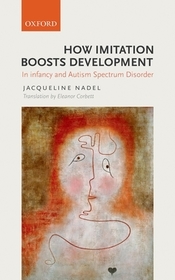
How Imitation Boosts Development
In Infancy and Autism Spectrum Disorder
- Publisher's listprice GBP 52.00
-
23 478 Ft (22 360 Ft + 5% VAT)
The price is estimated because at the time of ordering we do not know what conversion rates will apply to HUF / product currency when the book arrives. In case HUF is weaker, the price increases slightly, in case HUF is stronger, the price goes lower slightly.
- Discount 10% (cc. 2 348 Ft off)
- Discounted price 21 130 Ft (20 124 Ft + 5% VAT)
Subcribe now and take benefit of a favourable price.
Subscribe
23 478 Ft

Availability
Out of print
Why don't you give exact delivery time?
Delivery time is estimated on our previous experiences. We give estimations only, because we order from outside Hungary, and the delivery time mainly depends on how quickly the publisher supplies the book. Faster or slower deliveries both happen, but we do our best to supply as quickly as possible.
Product details:
- Publisher OUP Oxford
- Date of Publication 31 July 2014
- ISBN 9780198704003
- Binding Paperback
- No. of pages272 pages
- Size 215x134x16 mm
- Weight 334 g
- Language English 0
Categories
Short description:
Why are humans able to imitate - from the very second they enter the world? In this book, a leading development psychologist explores the topic of imitation - looking at why we imitate and the possible benefits it might bring - in particular to those affected by Autism Spectrum Disorders. The book offers fascinating insights into a neglected topic.
MoreLong description:
It was Plato who famously stated that 'imitation is dangerous because it stifles creativity, hampers the development of personal identity and disrupts the perception of other people as unique beings'. There are some who still feel this way, and perhaps this explains why imitation has received less attention within the developmental literature than other human characteristics. So why are humans able to imitate - from the very second they enter the world? Can it have positive effects? Can it help us interact with others better? Can it even make us feel better about ourselves and our ability to influence and interact with the world around us?
In this book, a leading development psychologist explores the topic of imitation - looking at why we imitate and the possible benefits it might bring - in particular to those affected by Autism Spectrum Disorders. The book offers fascinating insights into an often neglected topic.
Table of Contents:
List of illustrations
Introduction: Imitation: the black sheep in the study of development
A little reminder
What imitation means
Imitation and development
What is imitation for?
What imitation can do for the infant
What can imitation do for children with autism?
The toolbox of imitation
Evaluating imitation in autism
Imitation - the overseer of development
Conclusion: Imitation: a contribution to an individual history of actions
Glossary
Bibliography
Index

