

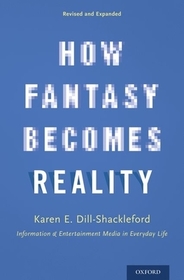
How Fantasy Becomes Reality
Information and Entertainment Media in Everyday Life, Revised and Expanded
- Publisher's listprice GBP 45.99
-
20 764 Ft (19 775 Ft + 5% VAT)
The price is estimated because at the time of ordering we do not know what conversion rates will apply to HUF / product currency when the book arrives. In case HUF is weaker, the price increases slightly, in case HUF is stronger, the price goes lower slightly.
- Discount 10% (cc. 2 077 Ft off)
- Discounted price 18 687 Ft (17 798 Ft + 5% VAT)
Subcribe now and take benefit of a favourable price.
Subscribe
20 764 Ft

Availability
printed on demand
Why don't you give exact delivery time?
Delivery time is estimated on our previous experiences. We give estimations only, because we order from outside Hungary, and the delivery time mainly depends on how quickly the publisher supplies the book. Faster or slower deliveries both happen, but we do our best to supply as quickly as possible.
Product details:
- Publisher OUP USA
- Date of Publication 28 January 2016
- ISBN 9780190239299
- Binding Hardback
- No. of pages280 pages
- Size 163x239x27 mm
- Weight 522 g
- Language English 0
Categories
Short description:
In this new edition of How Fantasy Becomes Reality, Karen E. Dill-Shackleford offers readers a greater understanding of what the current science of psychology tells us about life in our digital culture.
MoreLong description:
From smartphones to social media, from streaming videos to fitness bands, our devices bring us information and entertainment all day long, forming an intimate part of our lives. Their ubiquity represents a major shift in human experience, and although we often hold our devices dear, we do not always fully appreciate how their nearly constant presence can influence our lives for better and for worse.
In this second edition of How Fantasy Becomes Reality, social psychologist Karen E. Dill-Shackleford explains what the latest science tells us about how our devices influence our thoughts, feelings, and behaviors. In engaging, conversational prose, she discusses both the benefits and the risks that come with our current level of media saturation. The wide-ranging conversation explores Avatar, Mad Men, Grand Theft Auto, and Comic Con to address critical issues such as media violence, portrayals of social groups, political coverage, and fandom. Her conclusions will empower readers to make our favorite sources of entertainment and information work for us and not against us.
Professor Karen Dill has done a remarkable job in presenting the scientific facts about the huge (often harmful, sometimes helpful) impact that TV, films, video games, and music have on us all, and she has done so in a way that is engaging and easy to understand. Two additional aspects of this book are of particular importance: her science-based explanations of why most people believe that they are not influenced; and her recommendations for how people can take control of the media in their lives rather than continuing to be controlled by the media industries. In my view, this is a 'must read' for anyone who is concerned about the healthy development of children and the future of modern society.
Table of Contents:
Chapter 1. On Fantasy and Reality
Chapter 2. Fandom, Fantasy, and Reality
Chapter 3. Old and New Media in Everyday Life: From TV to Social Media
Chapter 4. Media Violence
Chapter 5. Representations of Social Groups in Media
Chapter 6. Advertising, Consumerism, and Health
Chapter 7. Media and Identity
Chapter 8. The Social Psychology of Political Coverage
Chapter 9. From the Passenger's Seat to the Driver's Seat
Notes
Bibliography
Index

