

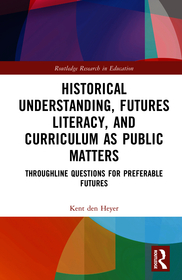
Historical Understanding, Futures Literacy, and Curriculum as Public Matters
Throughline Questions for Preferable Futures
Series: Routledge Research in Education;
-
GET 10% OFF
- Publisher's listprice GBP 171.99
-
77 653 Ft (73 955 Ft + 5% VAT)
The price is estimated because at the time of ordering we do not know what conversion rates will apply to HUF / product currency when the book arrives. In case HUF is weaker, the price increases slightly, in case HUF is stronger, the price goes lower slightly.
- Discount 10% (cc. 7 766 Ft off)
- Discounted price 69 887 Ft (66 560 Ft + 5% VAT)
69 887 Ft

Availability
Not yet published.
Why don't you give exact delivery time?
Delivery time is estimated on our previous experiences. We give estimations only, because we order from outside Hungary, and the delivery time mainly depends on how quickly the publisher supplies the book. Faster or slower deliveries both happen, but we do our best to supply as quickly as possible.
Product details:
- Edition number 1
- Publisher Routledge
- Date of Publication 24 November 2026
- ISBN 9781041291848
- Binding Hardback
- No. of pages196 pages
- Size 229x152 mm
- Language English
- Illustrations 14 Illustrations, black & white; 3 Halftones, black & white; 11 Line drawings, black & white; 20 Tables, black & white 700
Categories
Short description:
Through innovative concepts such as KINships (knowledge?ignorance?privilege relations), curriculum as encounter, and becoming ?story smart,? it outlines a path beyond both standardized schooling and decontextualized ?best practices? toward learning organized around ethical inquiry, Treaty relationships, and preferable collective futures.
MoreLong description:
This book asks a deceptively simple question: What is education for? Drawing on curriculum theory, history and social studies research, education philosophy, Indigenous scholarship, and futures studies, it argues that schooling too often socializes students into inherited ways of knowing while neglecting education?s deeper democratic purpose: enabling youth to make judgments about their nation-state and cultural inheritances and to distinguish between their probable and preferable futures. Engaging with timely debates in education, such as the emergence of AI, the author makes the case for a pedagogical approach centred on the use of ?throughline questions,? which ask students to connect subject matter to future thinking and critically examine their own role in shaping social worlds. Through innovative concepts such as KINships (knowledge?ignorance?privilege relations), curriculum as encounter, and becoming ?story smart,? the book outlines a path beyond both standardized schooling and decontextualized ?best practices? toward learning organized around ethical inquiry, Treaty relationships, and preferable collective futures.
Recommended reading for educators and researchers with interests in democratic education, curriculum design, and educational philosophy and civic education.
MoreTable of Contents:
Chapter 1 In what ways do KINships shape what we can/not bear to know? Commitments, KINships, and an ethics of learning Chapter 2: In what ways do we not belong to ourselves alone? Events and Source Codes Chapter 3 When does schooling become educational? Education Aims, Paradigms, and the Work of Becoming Chapter 4 In what ways do ?event?-ful encounters educate? Badiou, Socratic Education, and Learning in Relation with Indigenous Traditions Chapter 5:?? When AI Can Answer, What Remains to Be Taught? Throughline Questions and Civic Possibilities in Schools Chapter 6: Whose stories future our lives? Narrative Thinking, Historical Perspectives, and Scenarios in Social Studies Chapter 7 In what ways might we travel well through learning?s bear territory? KINships, Terror Management, and Thriving in the Educational Encounter
More
