

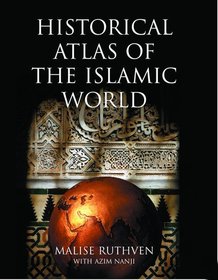
Historical Atlas of the Islamic World
- Publisher's listprice GBP 25.00
-
11 943 Ft (11 375 Ft + 5% VAT)
The price is estimated because at the time of ordering we do not know what conversion rates will apply to HUF / product currency when the book arrives. In case HUF is weaker, the price increases slightly, in case HUF is stronger, the price goes lower slightly.
- Discount 10% (cc. 1 194 Ft off)
- Discounted price 10 749 Ft (10 238 Ft + 5% VAT)
Subcribe now and take benefit of a favourable price.
Subscribe
11 943 Ft

Availability
Out of print
Why don't you give exact delivery time?
Delivery time is estimated on our previous experiences. We give estimations only, because we order from outside Hungary, and the delivery time mainly depends on how quickly the publisher supplies the book. Faster or slower deliveries both happen, but we do our best to supply as quickly as possible.
Product details:
- Publisher OUP Oxford
- Date of Publication 9 September 2004
- ISBN 9780198609971
- Binding Hardback
- No. of pages208 pages
- Size 286x224x22 mm
- Weight 1132 g
- Language English
- Illustrations full colour throughout 0
Categories
Short description:
The Historical Atlas of the Islamic World spans the period from pre-Islamic late antiquity to the present day. It provides an historical perspective on contemporary Islam. The maps, which employ the latest design techniques to show shifts in borders and populations, are supplemented by short essays on a variety of themes, plus maps, photographs, and diagrams.
MoreLong description:
There is without question immense general and academic interest in the Islamic world at present. After the attacks on New York and Washington in September 2001 and the wars on Afghanistan and Iraq, 'Islamic Fundamentalism' has come to be seen by many people in the West as the primary threat to world peace. Although not all scholars would agree that we are heading for a 'Clash on Civilizations' between Islam and the West, few would dispute that Islamic and Western cultures have
evolved very differently.
It is impossible to have a real understanding of current Islam without first understanding the historical perspective. Malise Ruthven, author of many acclaimed works on Islam and the Islamic world, including Fundamentalism, A Fury of God: The Islamist Attack on America, and Islam: A Very Short Introduction, and a regular commentator in the print and broadcast media, is ideally placed to provide this perspective. Thoroughly researched and very well written, the
Historical Atlas of the Islamic World is concise, accessible, and authoritative. It spans the period from pre-Islamic late antiquity to the present day, incorporating recent patterns of emigration from Muslim-majority countries and the independence of the post-Soviet Muslim states of Central Asia.
The maps use the latest design techniques to indicate the shifting nature of frontiers and population densities. In addition to historical maps of the changing internal and external boundaries of the Islamic World, there are maps showing the principle trade routes through which ideas and customs as well as goods were spread. Other maps and charts trace the rise and fall of Islamic dynasties and religious sects, the structure of cities, the distribution of minerals and water resources,
agricultural patterns, and archaeological sites.
The maps are accompanied by short essays on a wide range of themes, among them: all the countries and regions with Muslim majorities; institutions such as Shari'a (divine law) and fiqh (jurisprudence); philosophy; architecture; costume; the Muslim city; trade, commerce and manufacturing; the decorative arts; marriage and family life; tribal distributions; kinship, and dynastic power; mosque architecture, ritual, and devotional practices; Sufism; modernist and reformist trends; European
domination of the Islamic world; Islamic political movments; oil.
Table of Contents:
Introduction
Geophysical Map of the Muslim World
Muslim Languages and Ethnic Groups
Late Antiquity Before Islam
Muhammad's Mission and Campaigns
Expansion of Islam to 750
Expansion 751-1000
Sunnis, Shia, and Khariji 660-c.1000
Abbasid Caliphate under Harun al-Rashid
Spread of Islam, Islamic Law, and Arabic Language
Successor States to 1100
The Saljuq Era
Military Recruitment 900-1800
Fatimid Empire 909-1171
Trade Routes c.700-1500
Crusader Kingdoms
Sufi Orders 1100-1900
Ayyubids and Mamluks
The Mongol Invasion
Maghreb and Spain 650-1485
Subsaharan Africa - East
Subsaharan Africa - West
Jihad States
The Indian Ocean to 1499
The Indian Ocean 1500-1900
The Rise of the Ottomans to 1650
The Ottoman Empire 1650-1920
Iran 1500-2000
Central Asia to 1700
India 711-1971
Russian Expansion to Transcaucasia and Central Asia
Expansion of Islam in Southeast Asia 1000-1800
British, French, Dutch, and Russian Empires 19th-20th C
Nineteenth-Century Reform Movements
Modernization in Turkey
The Muslim World under Colonial Domination c.1920
Balkans, Cyprus, and Crete 1500-2000
Muslim Minorities in China
The Levant 1500-1920
Prominent Travellers
Britain in Egypt and Sudan in the 19th Century
France in North and West Africa
Growth of the Hajj and Other Places of Pilgrimage
Expanding Cities
Impact of Oil in the 20th Century
Water Resources with Israel-Palestine
The Arms Trade
Flashpoint Southeast Asia 1950-2000
Flashpoint Iraq 1917-2003
Afghanistan 1840-2002
Arabia and the Gulf 1839-1950
Rise of the Saudi State
Flashpoint Israel-Palestine
Flashpoint Gulf 1950-2003
Muslims in Western Europe
Muslims in North America
Mosques and Places of Worship in North America
Islamic Arts
Major Islamic Architectural Studies
World Distribution of Muslims 2000
World Terrorism 2003
Muslim Cinema
Internet Use
Democracy, Censorship, Human Rights, and Civil Society
Modern Movements, Organizations, and Influences
Chronology
Glossary
Further Reading
Acknowledgements
Index

