

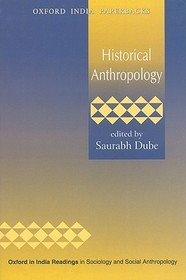
Historical Anthropology
Series: Oxford in India Readings in Sociology and Social Anthropology;
- Publisher's listprice GBP 12.99
-
6 205 Ft (5 910 Ft + 5% VAT)
The price is estimated because at the time of ordering we do not know what conversion rates will apply to HUF / product currency when the book arrives. In case HUF is weaker, the price increases slightly, in case HUF is stronger, the price goes lower slightly.
- Discount 10% (cc. 621 Ft off)
- Discounted price 5 585 Ft (5 319 Ft + 5% VAT)
Subcribe now and take benefit of a favourable price.
Subscribe
6 205 Ft

Availability
Only to order.
Why don't you give exact delivery time?
Delivery time is estimated on our previous experiences. We give estimations only, because we order from outside Hungary, and the delivery time mainly depends on how quickly the publisher supplies the book. Faster or slower deliveries both happen, but we do our best to supply as quickly as possible.
Product details:
- Publisher OUP India
- Date of Publication 27 November 2008
- ISBN 9780195699357
- Binding Paperback
- No. of pages444 pages
- Size 217x141x25 mm
- Weight 506 g
- Language English 0
Categories
Short description:
This book is the thirteenth in the OIRSSA series. It deals with the interchange-both theoretical and empirical-between the disciplines of history and anthropology over the last three decades.
MoreLong description:
The relationship between anthropology and history has been contradictory as also passionate and productive. The two have often displayed mistrust of the other discipline and at other times have underscored their key convergences. Over the last three decades, the interchange between the two disciplines have acquired a fresh purpose in theoretical and empirical studies. This has resulted in considerations for the history of anthropology and anthropology of history. This collection brings together the terrains and trajectories of the entangling of anthropology and history. It offers to students and scholars a wide-ranging domain of anthropological and historical endeavour under the rubric of historical anthropology--marking its departures, charting its contexts, exploring its characteristics and tracking its predicaments and possibilities.Conversations between anthropology and history have been approached by treating the two as disciplines. It explores formative orientations of anthropology to time and temporality, and of history to culture and tradition. It considers the more recent transformations of anthropology and history. It discusses important developments in study of pasts and communities, empire and nation, and culture and power in South Asia as part of a wider interplay between anthropology and history. In a nutshell, this volume attempts to open up the terms of historical anthropology.
MoreTable of Contents:
Preface; Introduction: Anthropology, History, Historical Anthropology (Saurabh Dube); Part 1: Formations; 1: Cloth, Clothes, and Colonialism (Bernard Cohn); 2: Negation (Ranajit Guha); 3: The Making of a Prophet (K.S. Singh); 4: Famine (Paul Greenough); Part 2: Genealogies; 5: Genealogy and Legend (Ravindra Jain); 6: Reading Time (Ishita Banerjee Dube); 7: Reconstructions of the Past (Susan Visvanathan); 8: A Contested Past (Saurabh Dube); Part 3: Communities; 9: The Bigoted Julaha (Gyanendra Pandey); 10: Rebellion (Malavika Kasturi); 11: Wildness: Livelihood, Kinship, and Gender (Ajay Skaria); 12: Time, Self, and Community (Veena Das); Part 4: Culture and Power; 13: Shoes (Ann G. Gold and Bhoju Ram Gujjar);
14: The Dialectics of Dussehra (Nandini Sundar); 15: Geographies of Empire (K. Sivaramakrishnan); 16: Gaze and Grasp (John Kelly); Part 5: Empire and Nation; 17: The Moral State (Peter van Der Veer); 18: The Policing of Tradition (Nicholas Dirks); 19: Partition and Violence (Shail Mayaram); 20: Is Khadi the Solution? (Emma Tarlo); Bibliographical Essay, Index

