

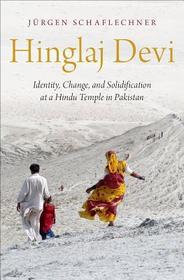
Hinglaj Devi
Identity, Change, and Solidification at a Hindu Temple in Pakistan
- Publisher's listprice GBP 115.00
-
51 922 Ft (49 450 Ft + 5% VAT)
The price is estimated because at the time of ordering we do not know what conversion rates will apply to HUF / product currency when the book arrives. In case HUF is weaker, the price increases slightly, in case HUF is stronger, the price goes lower slightly.
- Discount 10% (cc. 5 192 Ft off)
- Discounted price 46 730 Ft (44 505 Ft + 5% VAT)
Subcribe now and take benefit of a favourable price.
Subscribe
51 922 Ft

Availability
printed on demand
Why don't you give exact delivery time?
Delivery time is estimated on our previous experiences. We give estimations only, because we order from outside Hungary, and the delivery time mainly depends on how quickly the publisher supplies the book. Faster or slower deliveries both happen, but we do our best to supply as quickly as possible.
Product details:
- Publisher OUP USA
- Date of Publication 22 February 2018
- ISBN 9780190850524
- Binding Hardback
- No. of pages360 pages
- Size 239x157x25 mm
- Weight 635 g
- Language English 0
Categories
Short description:
In this book, Jürgen Schaflechner examines the political and cultural influences at work at the most influential Hindu pilgrimage site in Pakistan, Hinglaj Devi. The unique character of this pilgrimage site and its modern importance not only for Hindus, but also for Muslims and Sindhi nationalists, brings to the fore the lives of Hindu minorities in the Islamic Republic.
MoreLong description:
About two hundred kilometers west of the city of Karachi, in the desert of Baluchistan, Pakistan, sits the shrine of the Hindu Goddess Hinglaj. Despite the temple's ancient Hindu and Muslim history, an annual festival at Hinglaj has only been established within the last three decades, in part because of the construction of the Makran Coastal Highway, which connects the distant rural shrine with urban Pakistan. Now, an increasingly confident minority Hindu community has claimed Hinglaj as their main religious center, a site for undisturbed religious performance and expression.
In Hinglaj Devi, Jürgen Schaflechner studies literary sources in Hindi, Sanskrit, Sindhi, and Urdu alongside extensive ethnographical research at the shrine, examining the political and cultural influences at work at the temple and tracking the remote desert shrine's rapid ascent to its current status as the most influential Hindu pilgrimage site in Pakistan. Schaflechner introduces the unique character of this place of pilgrimage and shows its modern importance not only for Hindus, but also for Muslims and Sindhi nationalists. Ultimately, this is an investigation of the Pakistani Hindu community's beliefs and practices at their largest place of worship in the Islamic Republic today--a topic of increasing importance to Pakistan's contemporary society.
Drawing on six years of extensive ethnographic fieldwork and a wide-ranging literary study encompassing histor-ical sources in six languages, Jürgen Schaflechner brings to the forefront a much-neglected area of research, studying the Hindu goddess tradition and pilgrimage site of Hinglaj Devi in Balochistan, Pakistan.
Table of Contents:
Acknowledgments
Conventions for transliteration, transcription and sources
Introduction
The struggle over truth
Hinglaj in perspective
Historical Representations and recent changes
(Un)necessary hardships in "getting there"
Change and perseverance
Solidifying Hinglaj: Striving for a uniform tradition
Conclusion
Bibliography
Index

