

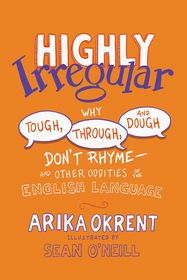
Highly Irregular
Why Tough, Through, and Dough Don't Rhyme—And Other Oddities of the English Language
- Publisher's listprice GBP 12.99
-
5 864 Ft (5 585 Ft + 5% VAT)
The price is estimated because at the time of ordering we do not know what conversion rates will apply to HUF / product currency when the book arrives. In case HUF is weaker, the price increases slightly, in case HUF is stronger, the price goes lower slightly.
- Discount 10% (cc. 586 Ft off)
- Discounted price 5 278 Ft (5 027 Ft + 5% VAT)
Subcribe now and take benefit of a favourable price.
Subscribe
5 864 Ft

Availability
Estimated delivery time: In stock at the publisher, but not at Prospero's office. Delivery time approx. 3-5 weeks.
Not in stock at Prospero.
Why don't you give exact delivery time?
Delivery time is estimated on our previous experiences. We give estimations only, because we order from outside Hungary, and the delivery time mainly depends on how quickly the publisher supplies the book. Faster or slower deliveries both happen, but we do our best to supply as quickly as possible.
Product details:
- Publisher OUP USA
- Date of Publication 3 June 2024
- ISBN 9780197760918
- Binding Paperback
- No. of pages272 pages
- Size 201x145x27 mm
- Weight 318 g
- Language English
- Illustrations 150 illustrations 492
Categories
Short description:
Highly Irregular is an illustrated history of English as told through all the things that are weird about it. Why are there so many silent letters? Why do we have irregular verbs? What is the deal with the word 'colonel'? The weirdness of English can be blamed on specific influences that shaped it, and in this book Arika Okrent investigates the many puzzles of our language to show how English came to be the way it is today.
MoreLong description:
For anyone who has ever wondered why English is so weird, an entertaining and expert tour of the most puzzling parts of our language.
Maybe you've been speaking English all your life, or maybe you learned it later on. But whether you use it just well enough to get your daily business done, or you're an expert with a red pen who never omits a comma or misplaces a modifier, you must have noticed that there are some things about this language that are just weird.
Perhaps you're reading a book and stop to puzzle over absurd spelling rules (Why are there so many ways to say '-gh'?), or you hear someone talking and get stuck on an expression (Why do we say "How dare you" but not "How try you"?), or your kid quizzes you on homework (Why is it "eleven and twelve" instead of "oneteen and twoteen"?). Suddenly you ask yourself, "Wait, why do we do it this way?" You think about it, try to explain it, and keep running into walls. It doesn't conform to logic. It doesn't work the way you'd expect it to. There doesn't seem to be any rule at all.
There might not be a logical explanation, but there will be an explanation, and this book is here to help.
In Highly Irregular, Arika Okrent answers these questions and many more. Along the way she tells the story of the many influences--from invading French armies to stubborn Flemish printers--that made our language the way it is today. Both an entertaining send-up of linguistic oddities and a deeply researched history of English, Highly Irregular is essential reading for anyone who has paused to wonder about our marvelous mess of a language.
In more than 40 brief, readable chapters, Okrent brings both erudition and wit to the history of English and the mechanisms of language change and all the quirky consequences ... Every language should have a book like this one.
Table of Contents:
What the Hell, English?
The Colonel of Truth: What is the deal with the word colonel?
Fairweather Vowels: Why is y a sometimes vowel?
Hey Large Spender: Why do we order a large drink and not a big one?
Crazy English: Why do we drive on a parkway and park on a driveway?
What the Hell is with What the Hell?
Blame the Barbarians
Thoroughly Tough, Right?: Why don't tough, through, and dough rhyme?
Getting and Giving the General Gist: Why are there two ways to say the letter g?
Egging them On: What is the egg doing in egg on?
I Ated All the Cookies: Why do we have irregular verbs?
It Goes by so Fastly: Why do we move slowly but not fastly? And step softly but not hardly?
Elegantly Clad and Stylishly Shod: Why is it clean-shaven and not clean-shaved?
Six of One, Half a Twoteen of the Other: Why is it eleven, twelve instead of oneteen, twoteen?
Woe is We: Why is it woe is me, not I am woe?
Blame the French
A Sizeable, Substantial, Extensive Vocabulary: Why are there so many synonyms?
Don't inSULT me with that INsult: Why are there noun-verb pairs that only differ by stress?
Without Fail: Why is it without fail and not failure or failing?
Ask the Poets Laureate: Why is it sum total and not total sum?
Of Unrequited Lof: Why isn't of spelled with a v?
Blame the Printing Press
Uninvited Ghuests: Why are ghost, ghastly, and ghoul spelled with a gh?
Gnat, Knot, Comb, Wrist: Why do we have silent consonants?
Coulda, Shoulda, Woulda: Why is there a silent l?
Peek, Peak, Piece, People: Why are there so many ways to write the 'ee' sound?
Crew, Grew, Stew, New...Sew?: Why don't sew and new rhyme?
Blame the snobs
Get Receipts on those Extra Letters: Why is there a p in receipt, an l in salmon, and a b in doubt?
Asthma, Phelgm, and Diarrhea: Why all the extra letters?
The Data are in on the Octopi: What's the deal with Latin plurals?
Too Much Discretion: Keeping discreet and discrete discrete, discreetly
Pick a Color/Colour: Can't we get this standardized/standardised?
Blame ourselves
Couth, Kempt, and Ruthful: Why have some words lost their better halves?
If it Ain't Broke, Don't Scramble It: Why is There no egg in eggplant?
Proving the Rule: How can an exception prove a rule?
How Dare You Say How Try You!: Why dare isn't like the other verbs
Release the Meese: Why isn't the plural of moose meese?
Why do Noses Run and Feet Smell?: A corny joke with a serious answer
Negative Fixation: Why can you say "this won't take long" but not "this will take long"?
Abbreviation Deflation: Why is there an r in Mrs.?
How it Comes to Be: How come we say how come?
Phrasal Verbs, Let's Go Over Them: But don't try to "go them over." (You can look them over though)
Terrible and Terrific, Awful and Awesome: How does the same root get opposite meanings?
Literally Messed Up: How did literally get to mean figuratively?
That's Enough, Now, English
Acknowledgments
Notes
Bibliography

