

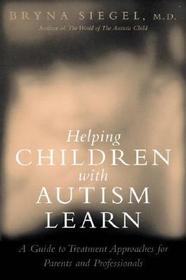
Helping Children with Autism Learn
Treatment Approaches for Parents and Professionals
- Publisher's listprice GBP 27.99
-
13 372 Ft (12 735 Ft + 5% VAT)
The price is estimated because at the time of ordering we do not know what conversion rates will apply to HUF / product currency when the book arrives. In case HUF is weaker, the price increases slightly, in case HUF is stronger, the price goes lower slightly.
- Discount 10% (cc. 1 337 Ft off)
- Discounted price 12 035 Ft (11 462 Ft + 5% VAT)
Subcribe now and take benefit of a favourable price.
Subscribe
13 372 Ft

Availability
printed on demand
Why don't you give exact delivery time?
Delivery time is estimated on our previous experiences. We give estimations only, because we order from outside Hungary, and the delivery time mainly depends on how quickly the publisher supplies the book. Faster or slower deliveries both happen, but we do our best to supply as quickly as possible.
Product details:
- Edition number New ed
- Publisher OUP USA
- Date of Publication 5 April 2007
- ISBN 9780195325065
- Binding Paperback
- No. of pages512 pages
- Size 235x156x32 mm
- Weight 694 g
- Language English 0
Categories
Short description:
Bryna Siegel gives parents of autistic children what they need most: hope. Her first book, The World of the Autistic Child, became an instant classic, illuminating the inaccessible minds of afflicted children. Now she offers an equally insightful, thoroughly practical guide to treating the learning disabilities associated with this heartbreaking disorder.
The trouble with treating autism, Siegel writes, is that it is a spectrum disorder - a combination of a number of symptoms and causes. To one extent or another, it robs the child of social bonds, language, and intimacy, but the extent varies dramatically in each case. The key is to understand each case of autism as a discrete set of learning disabilities, each of which must be treated individually. Siegel explains how to take an inventory of a child's particular disabilities, breaks down the various kinds unique to autism, discusses our current knowledge about each, and reviews the existing strategies for treating them. There is no simple cure for this multifarious disorder, she writes; instead, an individual program, with a unique array of specific treatments, must be constructed for each child. She gives practical guidance for fashioning such a program, empowering parents to take the lead in their child's treatment. At the same time, she cautions against the proliferating, but questionable, treatments hawked to afflicted families. She knows the panic to do something, anything, to help an autistic child, and she offers parents reassurance and support as well as sensible advice, combining knowledge from experience, theory and research.
For parents, autism in a child is heartbreaking. But it need not be overwhelming. Bryna Siegel offers a new understanding, and a practical, thoughtful approach, that will give parents new hope.
Long description:
Bryna Siegel gives parents of autistic children what they need most: hope. Her first book, The World of the Autistic Child, became an instant classic, illuminating the inaccessible minds of afflicted children. Now she offers an equally insightful, thoroughly practical guide to treating the learning disabilities associated with this heartbreaking disorder.
The trouble with treating autism, Siegel writes, is that it is a spectrum disorder - a combination of a number of symptoms and causes. To one extent or another, it robs the child of social bonds, language and intimacy, but the extent varies dramatically in each case. The key is to understand each case of autism as a discrete set of learning disabilities, each of which must be treated individually. Siegel explains how to take an inventory of a child's particular disabilities, breaks down the various kinds unique to autism, discusses our current knowledge about each, and reviews the existing strategies for treating them. There is no simple cure for this multifarious disorder, she writes, instead an individual program, with a unique array of specific treatments, must be constructed for each child. She gives practical guidance for fashioning such a program, empowering parents to take the lead in their child's treatment. At the same time, she cautions against the proliferating, but questionable treatments hawked to afflicted families. She knows the panic to do something, anything, to help an autistic child, and she offers parents reassurance and support as well as sensible advice, combining knowledge from experience, theory and research.
For parents, autism in a child is heartbreaking, but it need not be overwhelming. Bryna Siegel offers a new understanding, and a practical, thoughtful approach, that will give parents new hope.
"Besides writing in an accessible and often lighthearted style, Siegel has established an excellent and clearly defined structure for each chapter, providing a concise overview, thorough descriptions, and conclusions that help bridge the gap between readers with different backgrounds and familiarity with ASD."--Library Journal (starred review)
Table of Contents:
Part 1: The Fundamentals of Autistic Learning Style
Understanding the Origins of Autism and Its Meaning for Development
When Atypical Development and Typical Development Cross Paths
Autistic Learning Disabilities Defined: How Strengths Compensate for Weaknesses and Form Autism
Part 2: Autistic Learning Disabilities and Autistic Learning Styles: What Makes The World Of The Autistic Child Different?
Social Autistic Learning Disabilities: Description and Treatment
Autistic Learning Disabilities of Communication
Autistic Learning Disabilities of Communication: Treatments for the Pre-Verbal and Non-Verbal Child
Autistic Learning Disabilities of Communication: Treatments for the Verbal Child
Autistic Learning Disabilities in Relating to the World of Objects: Description and Treatment
Autistic Learning Disabilities and the Skills of Daily Living
Part 3: Methods of Teaching Children with Autism: How They Address Autistic Learning Disabilities and Autistic Learning Styles
Applied Behaviour Analysis and Discrete Trial Training: Separating Methods from Curriculum
The TEACCH Curriculum
Mainstreaming that Works: Too Accommodating or Really Included?
Model Programs and Exemplary Classes: What Can We Learn?
Putting the 'I' Back in IEP: Creating Individualized, Meaningful Learning Experiences
Further Readings for Teachers, Parents and Professionals
Appendix A: Autistic Learning Disabilities Inventory

