

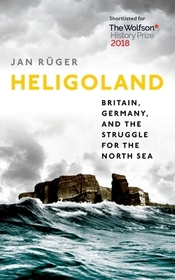
Heligoland
Britain, Germany, and the Struggle for the North Sea
- Publisher's listprice GBP 17.49
-
7 896 Ft (7 520 Ft + 5% VAT)
The price is estimated because at the time of ordering we do not know what conversion rates will apply to HUF / product currency when the book arrives. In case HUF is weaker, the price increases slightly, in case HUF is stronger, the price goes lower slightly.
- Discount 20% (cc. 1 579 Ft off)
- Discounted price 6 317 Ft (6 016 Ft + 5% VAT)
- Discount is valid until: 30 June 2026
Subcribe now and take benefit of a favourable price.
Subscribe
7 896 Ft

Availability
Estimated delivery time: In stock at the publisher, but not at Prospero's office. Delivery time approx. 3-5 weeks.
Not in stock at Prospero.
Why don't you give exact delivery time?
Delivery time is estimated on our previous experiences. We give estimations only, because we order from outside Hungary, and the delivery time mainly depends on how quickly the publisher supplies the book. Faster or slower deliveries both happen, but we do our best to supply as quickly as possible.
Product details:
- Publisher OUP Oxford
- Date of Publication 23 May 2019
- ISBN 9780199672479
- Binding Paperback
- No. of pages384 pages
- Size 216x147x28 mm
- Weight 396 g
- Language English
- Illustrations 28 black & white illustrations, 1 map 0
Categories
Short description:
The story of Heligoland, the North Sea island which for generations stood as a symbol of Anglo-German conflict. A fascinating microcosm of a long and often troubled relationship, covering two centuries and two world wars.
MoreLong description:
On 18 April 1947, British forces set off the largest non-nuclear explosion in history. The target was a small island in the North Sea, fifty miles off the German coast, which for generations had stood as a symbol of Anglo-German conflict: Heligoland.
A long tradition of rivalry was to come to an end here, in the ruins of Hitler's island fortress. Pressed as to why it was not prepared to give Heligoland back, the British government declared that the island represented everything that was wrong with the Germans: 'If any tradition was worth breaking, and if any sentiment was worth changing, then the German sentiment about Heligoland was such a one'.
Drawing on a wide range of archival material, Jan Rüger explores how Britain and Germany have collided and collaborated in this North Sea enclave. For much of the nineteenth century, this was Britain's smallest colony, an inconvenient and notoriously discontented outpost at the edge of Europe. Situated at the fault line between imperial and national histories, the island became a metaphor for Anglo-German rivalry once Germany had acquired it in 1890. Turned into a naval stronghold under the Kaiser and again under Hitler, it was fought over in both world wars. Heavy bombardment by the Allies reduced it to ruins, until the Royal Navy re-took it in May 1945. Returned to West Germany in 1952, it became a showpiece of reconciliation, but one that continues to wear the scars of the twentieth century.
Tracing this rich history of contact and conflict from the Napoleonic Wars to the Cold War, Heligoland brings to life a fascinating microcosm of the Anglo-German relationship. For generations this cliff-bound island expressed a German will to bully and battle Britain; and it mirrored a British determination to prevent Germany from establishing hegemony on the Continent. Caught in between were the Heligolanders and those involved with them: spies and smugglers, poets and painters, sailors and soldiers.
Far more than just the history of a small island in the North Sea, this is the compelling story of a relationship which has defined modern Europe.
Jan Rüger [...] has achieved the notable feat of telling a story almost none of us knows. His account of Heligoland's Napoleonic-era experience is a high spot, but the whole work is studded with unexpected gems about extraordinary people.
Table of Contents:
Prologue: Between Worlds
Edge of Europe
Nation and Empire
A Matter of Sentiment
Making Germans
Island Fortress
To Heligoland and Back
Disarming Germany
Hitler's Island
Out of Ruins
Epilogue: No More Heligolands
List of Abbreviations
Notes
Sources
Acknowledgements
Picture Credits
Index

