

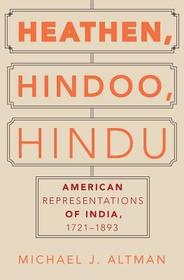
Heathen, Hindoo, Hindu
American Representations of India, 1721-1893
- Publisher's listprice GBP 41.49
-
19 821 Ft (18 877 Ft + 5% VAT)
The price is estimated because at the time of ordering we do not know what conversion rates will apply to HUF / product currency when the book arrives. In case HUF is weaker, the price increases slightly, in case HUF is stronger, the price goes lower slightly.
- Discount 10% (cc. 1 982 Ft off)
- Discounted price 17 839 Ft (16 989 Ft + 5% VAT)
Subcribe now and take benefit of a favourable price.
Subscribe
19 821 Ft

Availability
Estimated delivery time: Expected time of arrival: end of January 2026.
Not in stock at Prospero.
Why don't you give exact delivery time?
Delivery time is estimated on our previous experiences. We give estimations only, because we order from outside Hungary, and the delivery time mainly depends on how quickly the publisher supplies the book. Faster or slower deliveries both happen, but we do our best to supply as quickly as possible.
Product details:
- Publisher OUP USA
- Date of Publication 7 September 2017
- ISBN 9780190654924
- Binding Hardback
- No. of pages198 pages
- Size 236x155x22 mm
- Weight 408 g
- Language English
- Illustrations 8 illus. 0
Categories
Short description:
Heathen, Hindoo, Hindu is a groundbreaking analysis of American representations of religion in India before the turn of the twentieth century. Before Americans wrote about "Hinduism," they wrote about "heathenism," "the religion of the Hindoos," and "Brahmanism." Americans used the heathen, Hindoo, and Hindu as an other against which they represented themselves. The questions of American identity, classification, representation and the definition of "religion" that animated descriptions of heathens, Hindoos, and Hindus in the past still animate American debates today.
MoreLong description:
Heathen, Hindoo, Hindu is a groundbreaking analysis of American representations of religion in India before the turn of the twentieth century. In their representations of India, American writers from a variety of backgrounds described "heathens," "Hindoos," and, eventually "Hindus." Before Americans wrote about "Hinduism," they wrote about "heathenism," "the religion of the Hindoos," and "Brahmanism." Various groups interpreted the religions of India for their own purposes. Cotton Mather, Hannah Adams, and Joseph Priestley engaged the larger European Enlightenment project of classifying and comparing religion in India. Evangelical missionaries used images of "Hindoo heathenism" to raise support at home. Unitarian Protestants found a kindred spirit in the writings of Bengali reformer Rammohun Roy. Transcendentalists and Theosophists imagined the contemplative and esoteric religion of India as an alternative to materialist American Protestantism, while popular magazines and common school books used the image of dark, heathen, despotic India to buttress Protestant, white, democratic American identity. Americans used the heathen, Hindoo, and Hindu as an other against which they represented themselves. The questions of American identity, classification, representation and the definition of "religion" that animated descriptions of heathens, Hindoos, and Hindus in the past still animate American debates today.
Altman successfully disrupts and expands the typical narrative about Hinduism in America by carefully documenting encounters with South Asian religious practices, objects, and texts. He also precisely details how notions of America as a white Protestant democracy and chosen nation were formed against representations of India as dark, uncivilized, and despotic. Altman's book is well-researched, well-organized, and well-written. His argument showing how Americans constructed their identity and religion through differences and similarities with an imagined Other is compelling and insightful. He makes a valuable contribution to academic discourse and public conversation about Hinduism in the American religious landscape.
Table of Contents:
Acknowledgements
Preface
Prologue
Chapter 1: Heathens and Hindoos in Early America
Chapter 2: Missionaries, Unitarians, and Raja Rammohun Roy
Chapter 3: Hindoo Religion in American National Culture
Chapter 4: Transcendentalism, Brahmanism, and Universal Religion
Chapter 5: The Theosophical Quest for Occult Power
Chapter 6: Putting the "Religion" in the World's Parliament of Religion
Epilogue:

