

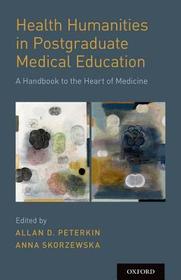
Health Humanities in Postgraduate Medical Education
- Publisher's listprice GBP 37.99
-
18 149 Ft (17 285 Ft + 5% VAT)
The price is estimated because at the time of ordering we do not know what conversion rates will apply to HUF / product currency when the book arrives. In case HUF is weaker, the price increases slightly, in case HUF is stronger, the price goes lower slightly.
- Discount 10% (cc. 1 815 Ft off)
- Discounted price 16 334 Ft (15 557 Ft + 5% VAT)
Subcribe now and take benefit of a favourable price.
Subscribe
18 149 Ft

Availability
printed on demand
Why don't you give exact delivery time?
Delivery time is estimated on our previous experiences. We give estimations only, because we order from outside Hungary, and the delivery time mainly depends on how quickly the publisher supplies the book. Faster or slower deliveries both happen, but we do our best to supply as quickly as possible.
Product details:
- Publisher OUP USA
- Date of Publication 27 September 2018
- ISBN 9780190849900
- Binding Paperback
- No. of pages360 pages
- Size 137x206x22 mm
- Weight 376 g
- Language English 0
Categories
Short description:
Arts and humanities education is widespread in undergraduate but almost non-existent in postgraduate medical education where it is arguably more helpful. This book fills that gap. It covers a wide range of arts and humanities including film, theatre, narrative, visual art, history, ethics and social sciences. It also touches on interprofessional education, research in the medical humanities and fundraising. It is not only a hands-on guide to creating arts- and humanities-base programming, but provides literature reviews and a theoretical discussion on each topic. Each chapter has appendices with lesson plans and resources.
MoreLong description:
Most medical schools in the US, Canada and UK now incorporate some form of arts and humanities-based teaching into their curricula. What happens in residency is another story. Most postgraduate programs do not continue the thread of such teaching although many residents would like to deepen their understanding of the medical humanities before they move into practice. The humanities emphasize "the human side of medicine", and can provide a counterpoint to the reductionism of evidence-based medicine and technological hubris for young doctors as they apply new knowledge and skills in ambiguous, real-life encounters with patients who are living with complicated health problems.
Humanities-based education can help both sides of the relationship: programs are shown to reduce burnout and mental health issues in young physicians, and can also help learning practitioners grapple with the most difficult aspects of their craft: how does one persuade patients on a course of treatment, while respecting informed consent? How does one work with families? How does one listen to and treat patients exhibiting self-harm tendencies? Available research may demonstrate the efficacy of such exposures, but provide little practical advice or resources for setting up programs across specialty and sub-specialty disciplines.
Health Humanities in Post-Graduate Medical Education will fill this gap in knowledge translation for the thousands of residency programs worldwide, allowing educators, supervisors, and residents themselves to create robust and educationally sound workshops, seminars, study groups, lecture series, research and arts-based projects, publications and events.
I found this book very thoughtfully compiled and I recommend it for health professions' educators with an interest in the medical humanities. They will certainly benefit from the collated wisdom contained within its pages.
Table of Contents:
Foreword-At the Coalface: Engaging the Humanities in Medical Education
Arno K. Kumagai
Acknowledgments
Contributors
About the Authors
1. Why Are the Health Humanities Relevant (and Vital) in Postgraduate Medical Education?
Anna Skorzewska and Allan D. Peterkin
2. Redirecting the Clinical Gaze: Film as a Tool of Critical Reflection in Residency Training
Elysse Leonard and Michael Tau
3. Narrative Medicine in Postgraduate Medical Education: Practices, Principles, Paradoxes
Shannon Arntfield and Kathryn Hynes
4. "Learning on the Job": Ethics in Postgraduate Medical Education
Chryssa McAlister, Mona Gupta, Carrie Bernard, Neda Ghiam, and Philip C. Hébert
5. The Visible Curriculum
Eva-Marie Stern and Shelley Wall
6. Teaching the Social Sciences in Residency
Zach Feilchenfeld, Ayelet Kuper, Farah Friesen, Amanda Chen, and Cynthia Whitehead
7. The Use of Theater with Medical Residents: An Embodied Approach to Learning About Self and Other
L. J. Nelles, Peggy Hamilton, Paul Robert D'Alessandro, Jeremy Rezmovitz, Lu Gao, Suvendrini Lena, and Anna Skorzewska
8. Promoting Collaborative Competencies: Using the Arts and the Humanities to Enhance Relational Practice and Teamwork
Sylvia Langlois and Karen Gold
9. Teaching History of Medicine/Healthcare in Residency
Edward Shorter and Susan E. Bélanger
10. Difficult Conversations: Evaluating the Medical Humanities
Martina Kelly
11. How to Fund and Promote Arts-Based Initiatives in Postgraduate Medical Education
Robert Pierre Tomas
Afterword
Craig Irvine
Appendix: Suggested Readings and Resources

