

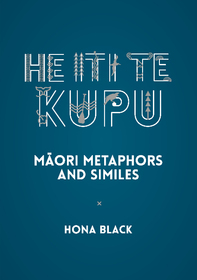
He Iti Te Kupu
M--ori Metaphors and Similes
- Publisher's listprice GBP 22.99
-
10 379 Ft (9 885 Ft + 5% VAT)
The price is estimated because at the time of ordering we do not know what conversion rates will apply to HUF / product currency when the book arrives. In case HUF is weaker, the price increases slightly, in case HUF is stronger, the price goes lower slightly.
- Discount % (cc. 0 Ft off)
- Discounted price 0 Ft (0 Ft + 5% VAT)
Subcribe now and take benefit of a favourable price.
Subscribe
10 379 Ft

Availability
Estimated delivery time: In stock at the publisher, but not at Prospero's office. Delivery time approx. 3-5 weeks.
Not in stock at Prospero.
Why don't you give exact delivery time?
Delivery time is estimated on our previous experiences. We give estimations only, because we order from outside Hungary, and the delivery time mainly depends on how quickly the publisher supplies the book. Faster or slower deliveries both happen, but we do our best to supply as quickly as possible.
Product details:
- Publisher University of Hawai'i Press
- Date of Publication 31 May 2022
- ISBN 9780947506919
- Binding Paperback
- No. of pages232 pages
- Size 210x150x18 mm
- Weight 388 g
- Language English 208
Categories
Short description:
Presents nearly 500 sayings that draw a comparison between something (often the natural world) and people, events or contexts. Written in Maori and English, this accessible guide explains the use, meaning and context of a host of the principal figures of speech in the Maori language.
MoreLong description:
He Iti te Kupu contains nearly 500 sayings that draw a comparison between something (often the natural world) and people, events or contexts. Written in Māori and English, this accessible guide explains the use, meaning and context of a host of the principal figures of speech in the Māori language.
Divided into themes, including birds of the land and sea, parts of the body, acknowledgements, animals and insects.
The title derives from the proverb, ‘The words are small, yet their meanings are substantial,’ highlighting the importance of these sayings in the landscape of Māori language learning and speaking.
This volume will be an invaluable resource for anyone seeking to use Māori figures of speech — whether in te reo or English — as well as students and speakers of the language.

